B-100 Gels
by Carlson · Softgel Capsule
Supplement facts from the label of B-100 Gels by Carlson: Calories 20 Calorie(s), Total Fat 1.5 Gram(s), Protein 1.0 Gram(s), Thiamine 100 mg….
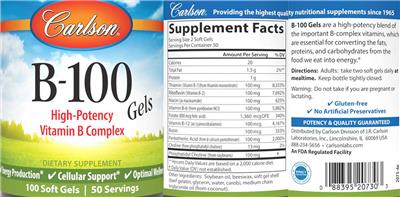
Supplement Facts
| Ingredient | Per serving | % DV | Upper limit (adults) |
|---|---|---|---|
| Calories | 20 Calorie(s) | — | — |
| Total Fat | 1.5 Gram(s) | 2% | — |
| Protein | 1.0 Gram(s) | — | — |
| Thiamine (Thiamine Mononitrate, Vitamin B1) | 100 mg | 8,333% | — |
| Riboflavin (Vitamin B2) | 100 mg | 7,692% | — |
| Niacin (Niacinamide) | 100 mg | 625% | — |
| Vitamin B6 (Pyridoxine Hydrochloride) | 100 mg | 5,882% | 100 mg · 100% at label max |
| Folate | 1,360 mcg DFE | 340% | — |
| └ Folic Acid | 800 mcg | — | 1,000 mcg · 80% at label max |
| Vitamin B12 (Cyanocobalamin) | 100 mcg | 4,167% | — |
| Biotin | 100 mcg | 333% | — |
| Pantothenic Acid (D-Calcium Pantothenate) | 100 mg | 2,000% | — |
| Choline (Phosphatidylcholine) | 13 mg | 2% | 3,500 mg · 0% at label max |
| Phosphatidylcholine (Soybean) | 100 mg | — | — |
Upper limits: NIH ODS Fact Sheets for Health Professionals. Compared only where the unit converts and the limit applies to the form on the label.
On the label
For: Adult (18 - 50 Years) · Women (not pregnant or lactating) · Gluten Free
Claim types: Nutrient · All Other · Structure/Function
Formula re: Contains: High-Potency Vitamin B Complex
Formulation re: Other: Energy Production Cellular Support Optimal Wellness
Brand IP Statement(s) re: (c), (TM), (SM): Carlson Providing the highest quality nutritional supplements since 1965
Formulation re: Other: B-100 Gels are a high-potency blend of the important B-complex vitamins, which are essential for converting the fats, proteins, and carbohydrates from the food we eat into energy.
Suggested/Recommended/Usage/Directions: Directions: Adults: take two soft gels daily at mealtime.
Storage: Keep bottle tightly closed.
This page repeats what the label says and the official upper limits for healthy adults. It is not medical advice: ask a doctor, pharmacist or registered dietitian about your own intake, especially if you are pregnant, take medicines or have a health condition.
Label data: NIH Office of Dietary Supplements, Dietary Supplement Label Database (dsld.od.nih.gov), public domain. Upper limits: NIH ODS Fact Sheets for Health Professionals (values from the Institute of Medicine, Food and Nutrition Board).