Acetyl-L-Carnitine 500 mg
by Protocol For Life Balance · Capsule
Supplement facts from the label of Acetyl-L-Carnitine 500 mg by Protocol For Life Balance: Acetyl-L-Carnitine 1.0 Gram(s).
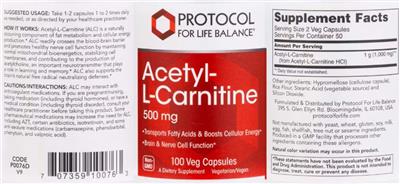
Supplement Facts
| Ingredient | Per serving | % DV | Upper limit (adults) |
|---|---|---|---|
| Acetyl-L-Carnitine (Acetyl-L-Carnitine Hydrochloride) | 1.0 Gram(s) | — | — |
Upper limits: NIH ODS Fact Sheets for Health Professionals. Compared only where the unit converts and the limit applies to the form on the label.
On the label
For: Vegan · Vegetarian · Adult (18 - 50 Years) · Gluten Free · Dairy Free
Claim types: All Other · Structure/Function
Suggested/Recommended/Usage/Directions: Suggested Usage: Take 1-2 capsules 1 to 2 times daily as needed, or as directed by your healthcare practitioner.
Formula re: Contains: How it works: Acetyl-L-Carnitine (ALC) is a naturally occurring component of fat metabolism and cellular energy production. ALC readily crosses the blood-brain barrier and promotes healthy nerve cell function by maintaining normal mitochondrial bioenergetics, stabilizing cell membranes, and contributing to the production of acetylcholine, an important neurotransmitter that plays a role in learning
Precautions re: Pregnant or Nursing or Prescription Medications: Cautions/Interactions: ALC may interact with anticoagulant medications. If you are pregnant/nursing, taking medication (including thyroid hormones), or have a medical condition (including thyroid disorder), consult your healthcare practitioner before taking this product. Some pharmaceutical medications may increase the need for ALC, including AZT, certain antibiotics, isotretinoin, and some anti-s
Formulation re: Other: Transports fatty acids & boosts cellular energy Brain & nerve cell function
Formulation re: Does NOT Contain: Non-GMO
Formulation re: Vegetarian/Vegan: Vegetarian/Vegan
This page repeats what the label says and the official upper limits for healthy adults. It is not medical advice: ask a doctor, pharmacist or registered dietitian about your own intake, especially if you are pregnant, take medicines or have a health condition.
Label data: NIH Office of Dietary Supplements, Dietary Supplement Label Database (dsld.od.nih.gov), public domain. Upper limits: NIH ODS Fact Sheets for Health Professionals (values from the Institute of Medicine, Food and Nutrition Board).