Extreme Iso Whey Butter Biscuit
by Body Attack Sports Nutrition · Powder
Supplement facts from the label of Extreme Iso Whey Butter Biscuit by Body Attack Sports Nutrition: Energy 1,106 kJ, Energy 855 kJ, Energy 1,619 kJ, Fat 0.50 Gram(s)….
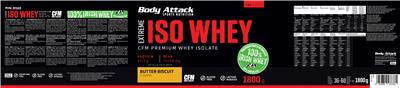
Supplement Facts
| Ingredient | Per serving | % DV | Upper limit (adults) |
|---|---|---|---|
| Energy | 1,106 kJ | — | — |
| Energy | 855 kJ | — | — |
| Energy | 1,619 kJ | — | — |
| Fat | 0.50 Gram(s) | — | — |
| └ Fatty Acids | 0.20 Gram(s) | — | — |
| Carbohydrates | 1.7 Gram(s) | — | — |
| └ Sugar | 0.60 Gram(s) | — | — |
| Protein | 45 Gram(s) | — | — |
| Salt | 0.49 Gram(s) | — | — |
| Lactose | 0.50 Gram(s) | — | — |
| Branched-Chain Amino Acids (L-Isoleucine, L-Leucine, L-Valine) | 10 Gram(s) | — | — |
Upper limits: NIH ODS Fact Sheets for Health Professionals. Compared only where the unit converts and the limit applies to the form on the label.
On the label
For: Adult (18 - 50 Years) · Gluten Free
Claim types: Nutrient · All Other
Formula re: Contains: Premium whey isolate CFM whey isolate 100% Irish whey 85% grass fed
Suggested/Recommended/Usage/Directions: Recommended dosage: Beginners: Stir 30 g powder (2 heaped scoops) into 300 ml of low-fat milk (1.5%). Advanced athletes: 50 g powder (3 heaped scoops) in 250 ml of water. Directions: On training days, drink about 30 minutes before or after an intensive workout. On non-training days, drink in the morning or evening.
Formula re: Contains: Protein blend as a protein concentrate with sweeteners and sugars for the preparation of a protein drink. Flavouring: Butter biscuit.
Suggested/Recommended/Usage/Directions: We recommend a varied, balanced diet and a healthy lifestyle.
Storage: If kept unopened in a cool, dry place, best before end of/lot no.: see bottom. Once opened, use up quickly. Keep away from direct heat and light.
Formulation re: Other: Made in Germany
This page repeats what the label says and the official upper limits for healthy adults. It is not medical advice: ask a doctor, pharmacist or registered dietitian about your own intake, especially if you are pregnant, take medicines or have a health condition.
Label data: NIH Office of Dietary Supplements, Dietary Supplement Label Database (dsld.od.nih.gov), public domain. Upper limits: NIH ODS Fact Sheets for Health Professionals (values from the Institute of Medicine, Food and Nutrition Board).