Vegetarian DHA 500 mg
by Carlson · Softgel Capsule
Supplement facts from the label of Vegetarian DHA 500 mg by Carlson: Calories 10 Calorie(s), Total Fat 1.0 Gram(s), Algal Oil 830 mg.
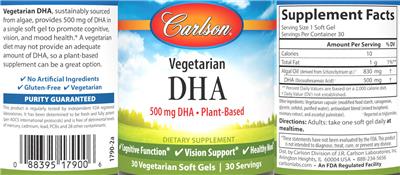
Supplement Facts
| Ingredient | Per serving | % DV | Upper limit (adults) |
|---|---|---|---|
| Calories | 10 Calorie(s) | — | — |
| Total Fat | 1.0 Gram(s) | 1% | — |
| Algal Oil (Schizochytrium sp.) | 830 mg | — | — |
| └ Docosahexaenoic Acid | 500 mg | — | — |
Upper limits: NIH ODS Fact Sheets for Health Professionals. Compared only where the unit converts and the limit applies to the form on the label.
On the label
For: Vegetarian · Adult (18 - 50 Years) · Gluten Free
Claim types: Nutrient · All Other · Structure/Function
Formula re: Contains: Vegetarian DHA, sustainably sourced from algae, provides 500 mg of DHA in a single soft gel to promote cognitive, vision, and mood health. A vegetarian diet may not provide an adequate amount of DHA, so a plant-based supplement can be a great option.
Formulation re: Does NOT Contain: No artificial ingredients Gluten-free
Formulation re: Vegetarian/Vegan: Vegetarian
Formulation re: Other: Purity guaranteed This product is regularly tested by independent FDA registered laboratories. It has been determined to be fresh and fully potent (per AOCS international protocols) and is free of detrimental levels of mercury, cadmium, lead, PCBs and 28 other contaminants.
Formulation re: Does NOT Contain: This product is regularly tested by independent FDA registered laboratories. It has been determined to be fresh and fully potent (per AOCS international protocols) and is free of detrimental levels of mercury, cadmium, lead, PCBs and 28 other contaminants.
Formula re: Contains: 500 mg DHA
This page repeats what the label says and the official upper limits for healthy adults. It is not medical advice: ask a doctor, pharmacist or registered dietitian about your own intake, especially if you are pregnant, take medicines or have a health condition.
Label data: NIH Office of Dietary Supplements, Dietary Supplement Label Database (dsld.od.nih.gov), public domain. Upper limits: NIH ODS Fact Sheets for Health Professionals (values from the Institute of Medicine, Food and Nutrition Board).