Electrolyte Capsules
by Dr. Berg · Capsule
Supplement facts from the label of Electrolyte Capsules by Dr. Berg: Calcium 38 mg, Magnesium 50 mg, Chloride 598 mg, Sodium 184 mg….
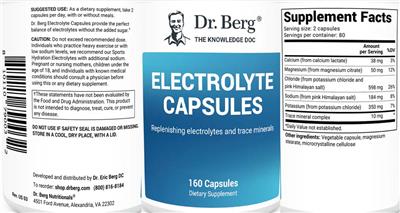
Supplement Facts
| Ingredient | Per serving | % DV | Upper limit (adults) |
|---|---|---|---|
| Calcium (Calcium Lactate) | 38 mg | 3% | 2,500 mg · 2% at label max |
| Magnesium (Magnesium Citrate) | 50 mg | 12% | 350 mg · 14% at label max |
| Chloride (Pink Himalayan Salt, Potassium Chloride) | 598 mg | 26% | — |
| Sodium (Pink Himalayan Salt) | 184 mg | 8% | — |
| Potassium (Potassium Chloride) | 350 mg | 7% | — |
| Trace Mineral Complex | 10 mg | — | — |
Upper limits: NIH ODS Fact Sheets for Health Professionals. Compared only where the unit converts and the limit applies to the form on the label.
On the label
For: Adult (18 - 50 Years)
Claim types: Nutrient · All Other · Structure/Function
Suggested/Recommended/Usage/Directions: Suggested use: As a dietary supplement, take 2 capsules per day, with or without meals.
Formula re: Contains: Dr. Berg Electrolyte Capsules provide the perfect balance of electrolytes without the added sugar.
Formulation re: Does NOT Contain: Dr. Berg Electrolyte Capsules provide the perfect balance of electrolytes without the added sugar.
Precautions re: All Other: Caution: Do not exceed recommended dose. Do not use if safety seal is damaged or missing.
Precautions re: All Other: Individuals who practice heavy exercise or with low sodium levels, we recommend our Sports Hydration Electrolytes with additional sodium.
Precautions re: Pregnant or Nursing or Prescription Medications: Pregnant or nursing mothers, children under the age of 18, and individuals with known medical conditions should consult a physician before using this or any dietary supplement.
This page repeats what the label says and the official upper limits for healthy adults. It is not medical advice: ask a doctor, pharmacist or registered dietitian about your own intake, especially if you are pregnant, take medicines or have a health condition.
Label data: NIH Office of Dietary Supplements, Dietary Supplement Label Database (dsld.od.nih.gov), public domain. Upper limits: NIH ODS Fact Sheets for Health Professionals (values from the Institute of Medicine, Food and Nutrition Board).