Slippery Elm Bark
by Baar Nature's Blessing · Capsule
Supplement facts from the label of Slippery Elm Bark by Baar Nature's Blessing: Total Carbohydrates 1.0 Gram(s), Slippery Elm 800 mg.
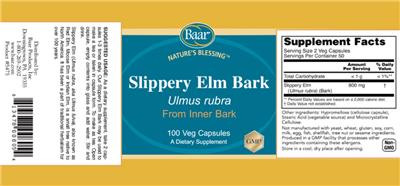
Supplement Facts
| Ingredient | Per serving | % DV | Upper limit (adults) |
|---|---|---|---|
| Total Carbohydrates | 1.0 Gram(s) | 1% | — |
| Slippery Elm (Ulmus rubra) | 800 mg | — | — |
Upper limits: NIH ODS Fact Sheets for Health Professionals. Compared only where the unit converts and the limit applies to the form on the label.
On the label
For: Adult (18 - 50 Years) · Gluten Free · Dairy Free
Claim types: All Other
Suggested/Recommended/Usage/Directions: Suggested usage: As a dietary supplement, take 2 capsules 1-3 times daily. Our Slippery Elm Bark may be used to make a tea or taken in capsule form. To make as tea: Open capsule, empty contents into glass and add water. Stir and drink.
Formula re: Contains: Slippery Elm (Ulmus rubra, aka Ulmus fulva), also known as Red Elm, Moose Elm, or Indian Elm, is a small tree native to North America. It has been a part of traditional herbalism for over 100 years.
Formula re: Contains: Ulmus rubra from inner bark
Seals/Symbols: GMP
Formulation re: Does NOT Contain: Not manufactured with yeast, wheat, gluten, soy, corn, milk, egg, fish, shellfish, tree nut or sesame ingredients. Non-GMO
Precautions re: Allergies: Not manufactured with yeast, wheat, gluten, soy, corn, milk, egg, fish, shellfish, tree nut or sesame ingredients. Produced in a GMP facility that processes other ingredients containing these allergens.
This page repeats what the label says and the official upper limits for healthy adults. It is not medical advice: ask a doctor, pharmacist or registered dietitian about your own intake, especially if you are pregnant, take medicines or have a health condition.
Label data: NIH Office of Dietary Supplements, Dietary Supplement Label Database (dsld.od.nih.gov), public domain. Upper limits: NIH ODS Fact Sheets for Health Professionals (values from the Institute of Medicine, Food and Nutrition Board).