BCAAs 4:1:1 Ratio
by Bluebonnet · Capsule
Supplement facts from the label of BCAAs 4:1:1 Ratio by Bluebonnet: Branched Chain Amino Acids 3,000 mg.
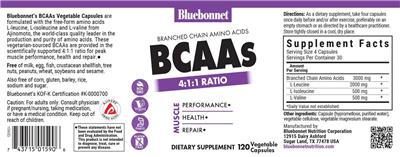
Supplement Facts
| Ingredient | Per serving | % DV | Upper limit (adults) |
|---|---|---|---|
| Branched Chain Amino Acids | 3,000 mg | — | — |
| └ L-Leucine | 2,000 mg | — | — |
| └ L-Isoleucine | 500 mg | — | — |
| └ L-Valine | 500 mg | — | — |
Upper limits: NIH ODS Fact Sheets for Health Professionals. Compared only where the unit converts and the limit applies to the form on the label.
On the label
For: Vegan · Vegetarian · Adult (18 - 50 Years) · Kosher · No Allergies · Gluten Free · Dairy Free · Sugar Free
Claim types: Nutrient · All Other · Structure/Function
Formula re: Contains: Bluebonnet's BCAAs Vegetable Capsules are formulated with the free-form amino acids L-leucine, L-isoleucine and L-valine from Ajinomoto, the world-class quality leader in the production and purity of amino acids. These vegetarian-sourced BCAAs are provided in the scientifically supported 4:1:1 ratio for peak muscle performance, health and repair.
Formulation re: Does NOT Contain: Free of milk, egg, fish, crustacean shellfish, tree nuts, peanuts, wheat, soybeans and sesame. Also free of corn, gluten, barley, rice, sodium and sugar.
Formula re: Kosher: Bluebonnet's KOF-K Certification #K-0000700
Precautions re: Children: Caution: For adults only.
Precautions re: Pregnant or Nursing or Prescription Medications: Consult physician if pregnant/nursing, taking medication, or have a medical condition.
Precautions re: Children: Keep out of reach of children.
This page repeats what the label says and the official upper limits for healthy adults. It is not medical advice: ask a doctor, pharmacist or registered dietitian about your own intake, especially if you are pregnant, take medicines or have a health condition.
Label data: NIH Office of Dietary Supplements, Dietary Supplement Label Database (dsld.od.nih.gov), public domain. Upper limits: NIH ODS Fact Sheets for Health Professionals (values from the Institute of Medicine, Food and Nutrition Board).