Vitamin B6 250 mg
by Life Extension · Capsule
Supplement facts from the label of Vitamin B6 250 mg by Life Extension: Vitamin B6 250 mg.
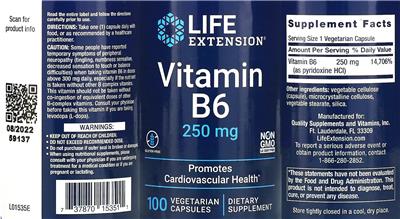
Supplement Facts
| Ingredient | Per serving | % DV | Upper limit (adults) |
|---|---|---|---|
| Vitamin B6 (Pyridoxine Hydrochloride) | 250 mg | 14,706% | 100 mg · 250% at label max ⚠ |
⚠ Above the upper limit: at the most servings a day printed on the label, at least one ingredient goes above the adult UL. Some ULs apply only to supplemental forms (shown on each ingredient page).
Upper limits: NIH ODS Fact Sheets for Health Professionals. Compared only where the unit converts and the limit applies to the form on the label.
On the label
For: Adult (18 - 50 Years) · Gluten Free
Claim types: All Other · Structure/Function
Precautions re: All Other: Read the entire label and follow the directions carefully prior to use.
Suggested/Recommended/Usage/Directions: Directions: Take one (1) capsule daily with food, or as recommended by a healthcare practitioner.
Precautions re: All Other: Caution: Some people have reported temporary symptoms of peripheral neuropathy (tingling, numbness, sensation, decreased sensation to touch or balance difficulties) when taking vitamin B6 in doses above 300 mg daily, especially if the nutrient is taken without other B complex vitamins. This vitamin should not be taken without co-ingestion of equivalent doses of other B-complex vitamins.
Precautions re: Pregnant or Nursing or Prescription Medications: Consult your physician before taking this vitamin if you are taking levodopa (L-dopa).
Precautions re: Children: Warnings: Keep out of reach of children.
Precautions re: All Other: Do not exceed recommended dose. Do not purchase if outer seal is broken or damaged.
This page repeats what the label says and the official upper limits for healthy adults. It is not medical advice: ask a doctor, pharmacist or registered dietitian about your own intake, especially if you are pregnant, take medicines or have a health condition.
Label data: NIH Office of Dietary Supplements, Dietary Supplement Label Database (dsld.od.nih.gov), public domain. Upper limits: NIH ODS Fact Sheets for Health Professionals (values from the Institute of Medicine, Food and Nutrition Board).