Mineral Xcel
by Neurobiologix · Capsule
Supplement facts from the label of Mineral Xcel by Neurobiologix: Calcium 122 mg, Phosphorus 18 mg, Magnesium 60 mg, Zinc 15 mg….
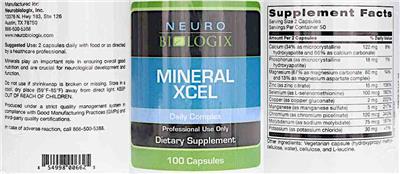
Supplement Facts
| Ingredient | Per serving | % DV | Upper limit (adults) |
|---|---|---|---|
| Calcium (Calcium Carbonate, Microcrystalline Hydroxyapatite) | 122 mg | 9% | 2,500 mg · 5% at label max |
| Phosphorus (Microcrystalline Hydroxyapatite) | 18 mg | 1% | 4,000 mg · 0% at label max |
| Magnesium (Magnesium Aspartate, Magnesium Carbonate) | 60 mg | 14% | 350 mg · 17% at label max |
| Zinc (Zinc Citrate) | 15 mg | 136% | 40 mg · 38% at label max |
| Selenium (L-Selenomethionine) | 100 mcg | 182% | 400 mcg · 25% at label max |
| Copper (Copper Gluconate) | 2.0 mg | 222% | 10,000 mcg · 20% at label max |
| Manganese (Manganese Sulfate) | 5.0 mg | 217% | 11 mg · 45% at label max |
| Chromium (Chromium Picolinate) | 120 mcg | 343% | — |
| Molybdenum (Sodium Molybdate) | 75 mcg | 167% | 2,000 mcg · 4% at label max |
| Potassium (Potassium Chloride) | 30 mg | 1% | — |
Upper limits: NIH ODS Fact Sheets for Health Professionals. Compared only where the unit converts and the limit applies to the form on the label.
On the label
For: Adult (18 - 50 Years)
Claim types: Nutrient · All Other · Structure/Function
Suggested/Recommended/Usage/Directions: Suggested use: 2 capsules daily with food or as directed by a healthcare professional.
Formula re: Contains: Minerals play an important role in ensuring overall good nutrition and are crucial for neurological development and function.
Precautions re: All Other: Do not use if shrinkwrap is broken or missing.
Storage: Store in a cool, dry place (59 degrees F - 85 degrees F) away from direct light.
Precautions re: Children: Keep out of reach of children.
Formulation re: Other: Produced under a strict quality management system in compliance with Good Manufacturing Practices (GMPs) and third-party quality certifications.
This page repeats what the label says and the official upper limits for healthy adults. It is not medical advice: ask a doctor, pharmacist or registered dietitian about your own intake, especially if you are pregnant, take medicines or have a health condition.
Label data: NIH Office of Dietary Supplements, Dietary Supplement Label Database (dsld.od.nih.gov), public domain. Upper limits: NIH ODS Fact Sheets for Health Professionals (values from the Institute of Medicine, Food and Nutrition Board).