Pantethine 300 mg
by Protocol For Life Balance · Softgel Capsule
Supplement facts from the label of Pantethine 300 mg by Protocol For Life Balance: Pantethine 300 mg.
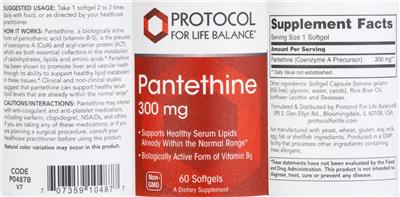
Supplement Facts
| Ingredient | Per serving | % DV | Upper limit (adults) |
|---|---|---|---|
| Pantethine | 300 mg | — | — |
Upper limits: NIH ODS Fact Sheets for Health Professionals. Compared only where the unit converts and the limit applies to the form on the label.
On the label
For: Adult (18 - 50 Years) · Gluten Free · Dairy Free
Claim types: Nutrient · All Other · Structure/Function
Suggested/Recommended/Usage/Directions: Suggested usage: Take 1 softgel 2 to 3 times daily with food, or as directed by your healthcare practitioner.
Formula re: Contains: How it works: Pantethine, a biologically active form of pantothenic acid (vitamin B-5), is the precursor of coenzyme A (CoA) and acyl-carrier protein (ACP), which are both essential cofactors in the metabolism of carbohydrates, lipids and amino acids. Pantethine has been shown to promote liver and vascular health through its ability to support healthy lipid metabolism in these tissues. Clinical an
Precautions re: Pregnant or Nursing or Prescription Medications: Cautions/Interactions: Pantethine may interact with anti-coagulant and anti-platelet medications, including warfarin, clopidogrel, NSAIDs, and others. If you are taking any of these medications, or if you are planning a surgical procedure, consult your healthcare practitioner before using this product.
Formulation re: Other: Natural color variation may occur in this product. Supports healthy serum lipids already within the normal range
Formula re: Contains: Biologically active form of vitamin B5
Formulation re: Does NOT Contain: Non-GMO
This page repeats what the label says and the official upper limits for healthy adults. It is not medical advice: ask a doctor, pharmacist or registered dietitian about your own intake, especially if you are pregnant, take medicines or have a health condition.
Label data: NIH Office of Dietary Supplements, Dietary Supplement Label Database (dsld.od.nih.gov), public domain. Upper limits: NIH ODS Fact Sheets for Health Professionals (values from the Institute of Medicine, Food and Nutrition Board).