Certified Organic Acacia Pure Powder
by Protocol For Life Balance · Powder
Supplement facts from the label of Certified Organic Acacia Pure Powder by Protocol For Life Balance: Calories 25 Calorie(s), Total Carbohydrates 6.0 Gram(s), Acacia Gum, Powder 6.5 Gram(s).
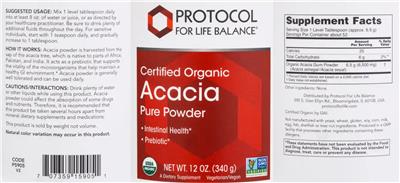
Supplement Facts
| Ingredient | Per serving | % DV | Upper limit (adults) |
|---|---|---|---|
| Calories | 25 Calorie(s) | — | — |
| Total Carbohydrates | 6.0 Gram(s) | 2% | — |
| Acacia Gum, Powder (Acacia senegal, Powder, Acacia seyal, Powder) | 6.5 Gram(s) | — | — |
Upper limits: NIH ODS Fact Sheets for Health Professionals. Compared only where the unit converts and the limit applies to the form on the label.
On the label
For: Vegan · Vegetarian · Adult (18 - 50 Years) · Organic · Gluten Free · Dairy Free
Claim types: All Other · Structure/Function
Suggested/Recommended/Usage/Directions: Suggested usage: Mix 1 level tablespoon daily into at least 8 oz. of water or juice, or as directed by your healthcare practitioner. Be sure to drink plenty of additional fluids throughout the day. For sensitive individuals, start with 1 teaspoon daily, and gradually increase to 1 tablespoon.
Formula re: Contains: How it works: Acacia powder is harvested from the sap of the acacia tree, which is native to parts of Africa, Pakistan, and India. It acts as a prebiotic that supports the vitality of the microorganisms that help maintain a healthy GI environment. Acacia powder is generally well tolerated and can be used daily.
Precautions re: All Other: Cautions/Interactions: Drink plenty of water or other liquids while using this product.
Precautions re: Pregnant or Nursing or Prescription Medications: Acacia powder could affect the absorption of some drugs and nutrients. Therefore, it is recommended that this product be taken several hours apart from mineral dietary supplements and medications.
Storage: This product is sold by weight not volume.
Formulation re: Other: Natural color variation may occur in this product.
This page repeats what the label says and the official upper limits for healthy adults. It is not medical advice: ask a doctor, pharmacist or registered dietitian about your own intake, especially if you are pregnant, take medicines or have a health condition.
Label data: NIH Office of Dietary Supplements, Dietary Supplement Label Database (dsld.od.nih.gov), public domain. Upper limits: NIH ODS Fact Sheets for Health Professionals (values from the Institute of Medicine, Food and Nutrition Board).