B-100 Complex
by 21st Century · Tablet or Pill
Supplement facts from the label of B-100 Complex by 21st Century: Thiamine 100 mg, Riboflavin 100 mg, Niacin 100 mg, Vitamin B6 100 mg….
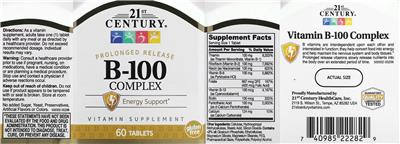
Supplement Facts
| Ingredient | Per serving | % DV | Upper limit (adults) |
|---|---|---|---|
| Thiamine (Thiamine Mononitrate, Vitamin B1) | 100 mg | 8,333% | — |
| Riboflavin (Vitamin B2) | 100 mg | 7,692% | — |
| Niacin (Niacinamide) | 100 mg | 625% | 35 mg · 286% at label max ⚠ |
| Vitamin B6 (Pyridoxine Hydrochloride) | 100 mg | 5,882% | 100 mg · 100% at label max |
| Folate | 667 mcg DFE | 167% | — |
| └ Folic Acid | 400 mcg | — | 1,000 mcg · 40% at label max |
| Vitamin B12 (Cyanocobalamin) | 100 mcg | 4,167% | — |
| Biotin | 100 mcg | 333% | — |
| Pantothenic Acid (D-Calcium Pantothenate) | 100 mg | 2,000% | — |
| Calcium (Calcium Carbonate) | 124 mg | 10% | 2,500 mg · 5% at label max |
⚠ Above the upper limit: at the most servings a day printed on the label, at least one ingredient goes above the adult UL. Some ULs apply only to supplemental forms (shown on each ingredient page).
Upper limits: NIH ODS Fact Sheets for Health Professionals. Compared only where the unit converts and the limit applies to the form on the label.
On the label
For: Adult (18 - 50 Years) · Gluten Free
Claim types: Nutrient · All Other · Structure/Function
Suggested/Recommended/Usage/Directions: Directions: As a vitamin supplement, adults take one (1) tablet daily with any meal or as directed by a healthcare provider.
Precautions re: All Other: Do not exceed recommended dosage.
All Other Content: Individual results may vary.
Precautions re: Pregnant or Nursing or Prescription Medications: Warning: Consult a healthcare provider prior to use if pregnant, nursing, on medications, have a medical condition or are planning a medical procedure.
Precautions re: All Other: Stop use and contact a physician if adverse reactions occur.
Precautions re: Children: Keep out of reach of children.
This page repeats what the label says and the official upper limits for healthy adults. It is not medical advice: ask a doctor, pharmacist or registered dietitian about your own intake, especially if you are pregnant, take medicines or have a health condition.
Label data: NIH Office of Dietary Supplements, Dietary Supplement Label Database (dsld.od.nih.gov), public domain. Upper limits: NIH ODS Fact Sheets for Health Professionals (values from the Institute of Medicine, Food and Nutrition Board).