TriEnza Powder
by Houston Enzymes · Powder
Supplement facts from the label of TriEnza Powder by Houston Enzymes: Enzyme Blend 528 mg….
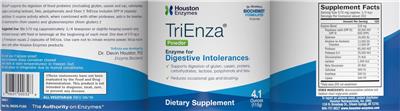
Supplement Facts
| Ingredient | Per serving | % DV | Upper limit (adults) |
|---|---|---|---|
| Enzyme Blend | 528 mg | — | — |
| └ Peptidase (Dipeptidyl Peptidase-IV) | 0.00 NP | — | — |
| └ Dipeptidyl Peptidase-IV | 0.00 NP | — | — |
| └ Xylanase | 0.00 NP | — | — |
| └ Amylase (Diastase) | 0.00 NP | — | — |
| └ Diastase | 0.00 NP | — | — |
| └ Protease | 0.00 NP | — | — |
| └ Protease 6.0 | 0.00 NP | — | — |
| └ Glucoamylase | 0.00 NP | — | — |
| └ Lactase | 0.00 NP | — | — |
| └ Beta-Glucanase | 0.00 NP | — | — |
| └ Cellulase | 0.00 NP | — | — |
| └ Invertase | 0.00 NP | — | — |
| └ Lipase | 0.00 NP | — | — |
Upper limits: NIH ODS Fact Sheets for Health Professionals. Compared only where the unit converts and the limit applies to the form on the label.
On the label
For: Vegetarian · Adult (18 - 50 Years)
Claim types: All Other · Structure/Function
Formulation re: Other: TriEnza supports the digestion of food proteins (including gluten, casein and soy) carbohydrates, sugars (including lactose), fats, polyphenols and fiber.
Formula re: Contains: TriEnza includes DPP IV (fipeptidyl peptidase 4) enzyme activity which, when combined with other proteases, aids in the breakdown of casomophin (from casein) and gluteomorphin (from gluten).
Suggested/Recommended/Usage/Directions: Suggested use: Mix 570 mg (approximately 1/4 teaspoon or slightly heaping scoopful using enclosed scoop) with food or beverage at the beginning of each meal.
All Other Content: One dose of 570 mg or 1/4 teaspoon equals 2 capsules of TriEnza.
Precautions re: All Other: Use care not to inhale enzyme powder.
Suggested/Recommended/Usage/Directions: TriEnza may be taken with other Houston Enzymes products.
This page repeats what the label says and the official upper limits for healthy adults. It is not medical advice: ask a doctor, pharmacist or registered dietitian about your own intake, especially if you are pregnant, take medicines or have a health condition.
Label data: NIH Office of Dietary Supplements, Dietary Supplement Label Database (dsld.od.nih.gov), public domain. Upper limits: NIH ODS Fact Sheets for Health Professionals (values from the Institute of Medicine, Food and Nutrition Board).