Creatine Monohydrate
by Onnit · Powder
Supplement facts from the label of Creatine Monohydrate by Onnit: Creatine Monohydrate, Micronized 5.0 Gram(s).
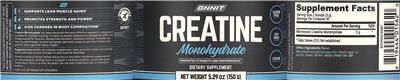
Supplement Facts
| Ingredient | Per serving | % DV | Upper limit (adults) |
|---|---|---|---|
| Creatine Monohydrate, Micronized | 5.0 Gram(s) | — | — |
Upper limits: NIH ODS Fact Sheets for Health Professionals. Compared only where the unit converts and the limit applies to the form on the label.
On the label
For: Vegan · Vegetarian · Adult (18 - 50 Years) · Gluten Free · Dairy Free
Claim types: All Other · Structure/Function
FDA Disclaimer Statement: These statements have not been evaluated by the Food and Drug Administration. This product is not intended to diagnose, treat, cure, or prevent any disease.
Formulation re: Other: Supports lean muscle gains Promotes strength and power Aids changes in body composition
Formula re: Contains: Creatine Monohydrate has been declared the most effective ergogenic supplement available for strength training. It works to restore adenosine triphosphate (ATP), the energy source for muscles, during short-duration, explosive activity. Creatine can help you sprint longer at your top speed, get more jumps at your best height, and perform more reps with heavy weight.
Suggested/Recommended/Usage/Directions: Suggested use: Adults, as a dietary supplement, take up to two scoops per serving mixed with eight ounces of water or your favorite beverage.
Precautions re: Pregnant or Nursing or Prescription Medications: Consults a medical doctor before taking this or any other nutritional supplement if you are pregnant, nursing, have or suspect a medical condition, or are taking any medications.
Storage: Store in a cool, dry place.
This page repeats what the label says and the official upper limits for healthy adults. It is not medical advice: ask a doctor, pharmacist or registered dietitian about your own intake, especially if you are pregnant, take medicines or have a health condition.
Label data: NIH Office of Dietary Supplements, Dietary Supplement Label Database (dsld.od.nih.gov), public domain. Upper limits: NIH ODS Fact Sheets for Health Professionals (values from the Institute of Medicine, Food and Nutrition Board).