Organ Ultra
by Xtendlife · Capsule
Supplement facts from the label of Organ Ultra by Xtendlife: Calories 15 Calorie(s), Total Fat 0.50 Gram(s), Protein 2.0 Gram(s), Iron 0.80 mg….
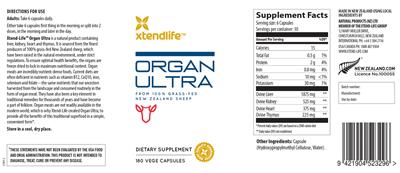
Supplement Facts
| Ingredient | Per serving | % DV | Upper limit (adults) |
|---|---|---|---|
| Calories | 15 Calorie(s) | — | — |
| Total Fat | 0.50 Gram(s) | 1% | — |
| Protein | 2.0 Gram(s) | 4% | — |
| Iron | 0.80 mg | 4% | 45 mg · 2% at label max |
| Sodium | 10 mg | 1% | — |
| Potassium | 30 mg | 1% | — |
| Ovine Liver | 1,875 mg | — | — |
| Ovine Kidney | 525 mg | — | — |
| Ovine Heart | 375 mg | — | — |
| Ovine Thymus | 225 mg | — | — |
Upper limits: NIH ODS Fact Sheets for Health Professionals. Compared only where the unit converts and the limit applies to the form on the label.
On the label
For: Adult (18 - 50 Years)
Claim types: All Other · Structure/Function
Suggested/Recommended/Usage/Directions: Directions for use Adults: Take 6 capsules daily. Either take 6 capsules first thing in the morning or split into 2 doses, in the morning and later in the day.
Formula re: Contains: Xtend-Life Organ Ultra is a natural product containing liver, kidney, heart and thymus. It is sourced from the finest producers of 100% grass-fed New Zealand sheep, which have been raised in the natural environment, under strict regulations. To ensure optimal health benefits, the organs are freeze dried to lock in maximum nutritional content. Organ meats are incredibly nutrient-dense foods. Curren
Storage: Store in a cool, dry place.
FDA Disclaimer Statement: These statements have not been evaluated by the USA Food and Drug Administration. This product is not intended to diagnose, treat, cure or prevent any disease.
Formula re: Contains: From 100% grass-fed New Zealand sheep
Seals/Symbols: Best Quality Guarantee
This page repeats what the label says and the official upper limits for healthy adults. It is not medical advice: ask a doctor, pharmacist or registered dietitian about your own intake, especially if you are pregnant, take medicines or have a health condition.
Label data: NIH Office of Dietary Supplements, Dietary Supplement Label Database (dsld.od.nih.gov), public domain. Upper limits: NIH ODS Fact Sheets for Health Professionals (values from the Institute of Medicine, Food and Nutrition Board).