LYTE Balance Electrolyte Concentrate
by LYTE Balance · Liquid
Supplement facts from the label of LYTE Balance Electrolyte Concentrate by LYTE Balance: Calories 0.00 Calorie(s), Fat 0.00 Gram(s), Carbohydrate 0.00 Gram(s), Protein 0.00 Gram(s)….
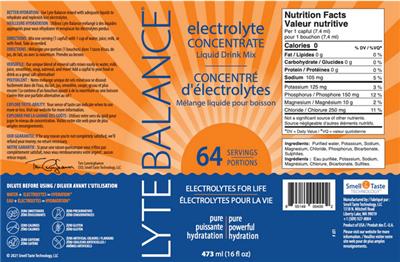
Supplement Facts
| Ingredient | Per serving | % DV | Upper limit (adults) |
|---|---|---|---|
| Calories | 0.00 Calorie(s) | — | — |
| Fat | 0.00 Gram(s) | 0% | — |
| Carbohydrate | 0.00 Gram(s) | 0% | — |
| Protein | 0.00 Gram(s) | 0% | — |
| Sodium | 105 mg | 5% | — |
| Potassium | 125 mg | 3% | — |
| Phosphorus | 150 mg | 12% | 4,000 mg |
| Magnesium | 10 Gram(s) | 2% | — |
| Chloride | 250 mg | 11% | — |
Upper limits: NIH ODS Fact Sheets for Health Professionals. Compared only where the unit converts and the limit applies to the form on the label.
On the label
For: Adult (18 - 50 Years) · Gluten Free
Claim types: Nutrient · All Other · Structure/Function
Formulation re: Other: Not a significant source of other nutrients.
Formulation re: Other: Better Hydration: Use Lyte Balance mixed with adequate liquids to rehydrate and replenish lost electrolytes.
Suggested/Recommended/Usage/Directions: Directions: Mix one serving (1 capful) with 1 cup of water, juice, milk, or, with food. Take as needed. Versatile: Our unique blend of mineral salts mixes easily in water, milk, smoothies, soup, oatmeal and more!
Formulation re: Other: Explore Taste Ability-Your sense of taste can indicate when to use more or less Visit our website for more information.
All Other Content: Our guarantee: If for any reason you're not completely satisfied we'll refund your money, no return necessary. Tom Cunningham CEO, Smell Taste Technology, LLC.
Suggested/Recommended/Usage/Directions: Dilute before using Water + electrolytes = Hydration
This page repeats what the label says and the official upper limits for healthy adults. It is not medical advice: ask a doctor, pharmacist or registered dietitian about your own intake, especially if you are pregnant, take medicines or have a health condition.
Label data: NIH Office of Dietary Supplements, Dietary Supplement Label Database (dsld.od.nih.gov), public domain. Upper limits: NIH ODS Fact Sheets for Health Professionals (values from the Institute of Medicine, Food and Nutrition Board).