Phosphatidyl Choline 420 mg
by Bluebonnet · Softgel Capsule
Supplement facts from the label of Phosphatidyl Choline 420 mg by Bluebonnet: Calories 10 Calorie(s), Total Fat 1.0 Gram(s), Lecithin 1,200 mg, Phosphatidylcholine 420 mg….
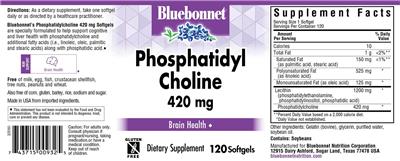
Supplement Facts
| Ingredient | Per serving | % DV | Upper limit (adults) |
|---|---|---|---|
| Calories | 10 Calorie(s) | — | — |
| Total Fat | 1.0 Gram(s) | 2% | — |
| └ Saturated Fat (Palmitic Acid, Stearic Acid) | 150 mg | 1% | — |
| └ Polyunsaturated Fat (Linoleic Acid) | 525 mg | — | — |
| └ Monounsaturated Fat (Oleic Acid) | 125 mg | — | — |
| Lecithin (Inositol Phosphatide, Phosphatidic Acid, Phosphatidylethanolamine) | 1,200 mg | — | — |
| Phosphatidylcholine | 420 mg | — | — |
Upper limits: NIH ODS Fact Sheets for Health Professionals. Compared only where the unit converts and the limit applies to the form on the label.
On the label
For: Adult (18 - 50 Years) · Gluten Free · Dairy Free · Sugar Free
Claim types: Nutrient · All Other · Structure/Function
Suggested/Recommended/Usage/Directions: Directions: As a dietary supplement, take one softgel daily or as directed by a healthcare practitioner.
Formula re: Contains: Bluebonnet's Phosphatidylcholine 420 mg softgels are specially formulated to help support cognitive and liver health with phosphatidylcholine and additional fatty acids (i.e., Linoleic, oleic, palmitic and stearic acids) along with phosphatidic acid.
Formulation re: Other: May Support Brain Health
Formulation re: Does NOT Contain: Free of milk, egg, fish, crustacean shellfish, tree nuts, peanuts, and wheat. Also free of corn, gluten, barley, rice, sodium and sugar.
Formulation re: Other: Made in USA from imported ingredients.
FDA Disclaimer Statement: This statement has not been evaluated by the Food and Drug Administration. This product is not intended to diagnose, treat, cure or prevent any disease.
This page repeats what the label says and the official upper limits for healthy adults. It is not medical advice: ask a doctor, pharmacist or registered dietitian about your own intake, especially if you are pregnant, take medicines or have a health condition.
Label data: NIH Office of Dietary Supplements, Dietary Supplement Label Database (dsld.od.nih.gov), public domain. Upper limits: NIH ODS Fact Sheets for Health Professionals (values from the Institute of Medicine, Food and Nutrition Board).