D. Salina Beta-Carotene 7500 mcg (25,000 IU)
by Bluebonnet · Softgel Capsule
Supplement facts from the label of D. Salina Beta-Carotene 7500 mcg (25,000 IU) by Bluebonnet: Vitamin A 7,500 mcg.
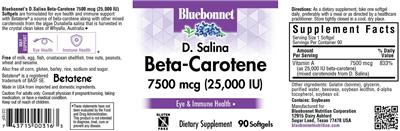
Supplement Facts
| Ingredient | Per serving | % DV | Upper limit (adults) |
|---|---|---|---|
| Vitamin A | 7,500 mcg | 833% | 3,000 mcg · 250% at label max ⚠ |
| └ Beta-Carotene (Mixed Carotenoids) | 25,000 IU | — | — |
⚠ Above the upper limit: at the most servings a day printed on the label, at least one ingredient goes above the adult UL. Some ULs apply only to supplemental forms (shown on each ingredient page).
Upper limits: NIH ODS Fact Sheets for Health Professionals. Compared only where the unit converts and the limit applies to the form on the label.
On the label
For: Adult (18 - 50 Years) · Gluten Free · Dairy Free · Sugar Free
Claim types: Nutrient · All Other · Structure/Function
Formula re: Contains: Bluebonnet's D. Salina Beta-Carotene 7500 mcg (25,000 IU) Softgels are formulated for eye health and immune support with betatene a source of beta-carotene along with other mixed carotenoids from the algae Dunaliella salina that is harvested in the crystal clean lakes of Whyalla, Australia.
Formulation re: Other: May support Eye health Immune health
Formulation re: Does NOT Contain: Free of milk, egg, fish, crustacean shellfish, tree nuts, peanuts, wheat and sesame. Also free of corn, gluten, barely, rice, sodium and sugar.
Brand IP Statement(s) re: (c), (TM), (SM): Betatene is a registered trademark of BASF SE.
Formula re: Contains: Betatene
Formulation re: Other: Made in USA from imported and domestic ingredients.
This page repeats what the label says and the official upper limits for healthy adults. It is not medical advice: ask a doctor, pharmacist or registered dietitian about your own intake, especially if you are pregnant, take medicines or have a health condition.
Label data: NIH Office of Dietary Supplements, Dietary Supplement Label Database (dsld.od.nih.gov), public domain. Upper limits: NIH ODS Fact Sheets for Health Professionals (values from the Institute of Medicine, Food and Nutrition Board).