Ultra Omega-3 Fish Oil
by NOW · Softgel Capsule
Supplement facts from the label of Ultra Omega-3 Fish Oil by NOW: Calories 10 Calorie(s), Total Fat 1.0 Gram(s), Fish Oil Concentrate 1.0 Gram(s)….
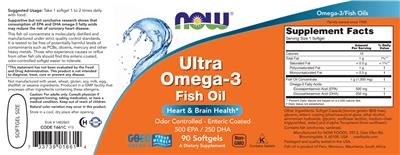
Supplement Facts
| Ingredient | Per serving | % DV | Upper limit (adults) |
|---|---|---|---|
| Calories | 10 Calorie(s) | — | — |
| Total Fat | 1.0 Gram(s) | 1% | — |
| └ Saturated Fat | 0.50 Gram(s) | 1% | — |
| └ Polyunsaturated Fat | 1.0 Gram(s) | — | — |
| └ Monounsaturated Fat | 0.50 Gram(s) | — | — |
| Fish Oil Concentrate (Anchovy, Sardine) | 1.0 Gram(s) | — | — |
| └ Omega-3 Fatty Acids | 0.00 NP | — | — |
| └ Eicosapentaenoic Acid | 500 mg | — | — |
| └ Docosahexaenoic Acid | 250 mg | — | — |
Upper limits: NIH ODS Fact Sheets for Health Professionals. Compared only where the unit converts and the limit applies to the form on the label.
On the label
For: Adult (18 - 50 Years) · Kosher · Halal · Gluten Free · Dairy Free
Claim types: Nutrient · All Other · Qualified Health · Structure/Function
Suggested/Recommended/Usage/Directions: Suggested usage: Take 1 softgel 1 to 2 times daily with food.
Formula re: Contains: Supportive but not conclusive research shows that consumption of EPA and DHA omega-3 fatty acids may reduce the risk of coronary heart disease.
Formula re: Contains: This fish oil concentrate is molecularly distilled and manufactured under strict quality control standards. It is tested to be free of potentially harmful levels of contaminants such as PCBs, dioxins, mercury and other heavy metals.
Formulation re: Does NOT Contain: It is tested to be free of potentially harmful levels of contaminants such as PCBs, dioxins, mercury and other heavy metals.
Formulation re: Other: Those who experience nausea or reflux from other fish oils should find this enteric-coated, odor-controlled softgel easier to tolerate.
FDA Disclaimer Statement: This statement has not been evaluated by the Food and Drug Administration. This product is not intended to diagnose, treat, cure or prevent disease.
This page repeats what the label says and the official upper limits for healthy adults. It is not medical advice: ask a doctor, pharmacist or registered dietitian about your own intake, especially if you are pregnant, take medicines or have a health condition.
Label data: NIH Office of Dietary Supplements, Dietary Supplement Label Database (dsld.od.nih.gov), public domain. Upper limits: NIH ODS Fact Sheets for Health Professionals (values from the Institute of Medicine, Food and Nutrition Board).