TMG Betaine - 1,000 mg
by NOW · Tablet or Pill
Supplement facts from the label of TMG Betaine - 1,000 mg by NOW: Trimethylglycine 3.0 Gram(s).
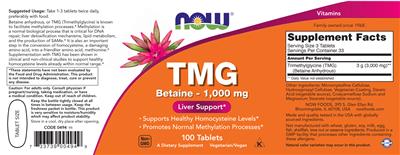
Supplement Facts
| Ingredient | Per serving | % DV | Upper limit (adults) |
|---|---|---|---|
| Trimethylglycine (Betaine Anhydrous) | 3.0 Gram(s) | — | — |
Upper limits: NIH ODS Fact Sheets for Health Professionals. Compared only where the unit converts and the limit applies to the form on the label.
On the label
For: Vegan · Vegetarian · Adult (18 - 50 Years) · Kosher · Gluten Free · Dairy Free
Claim types: All Other · Structure/Function
Suggested/Recommended/Usage/Directions: Suggested Usage: Take 1-3 tablets twice daily, preferably with food.
Formula re: Contains: Betaine Anhydrous, or TMG (Trimethylglycine) is known to facilitate methylation processes. Methylation is a normal biological process that is critical for DNA repair, liver detoxification mechanisms, lipid metabolism, and the production of SAMe. It is also an important step in the conversion of homocysteine, a damaging amino acid, into a friendlier amino acid, methionine. Supplementation with TMG
Suggested/Recommended/Usage/Directions: These statements have not been evaluated by the Food and Drug Administration. This product is not intended to diagnose, treat, cure or prevent any disease.
Precautions re: Children: Caution: For adults only. Keep out of reach of children.
Formulation re: Other: Consult physician if pregnant/nursing, taking medication, or have a medical condition.
Storage: Keep the bottle tightly closed at all times in between usage. Keep the freshness packet in bottle. This product is very sensitive to moisture/humidity which may affect product stability. Store in a cool, dry place after opening.
This page repeats what the label says and the official upper limits for healthy adults. It is not medical advice: ask a doctor, pharmacist or registered dietitian about your own intake, especially if you are pregnant, take medicines or have a health condition.
Label data: NIH Office of Dietary Supplements, Dietary Supplement Label Database (dsld.od.nih.gov), public domain. Upper limits: NIH ODS Fact Sheets for Health Professionals (values from the Institute of Medicine, Food and Nutrition Board).