Magnesium Glycinate
by NOW · Tablet or Pill
Supplement facts from the label of Magnesium Glycinate by NOW: Magnesium 200 mg.
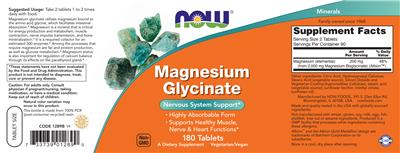
Supplement Facts
| Ingredient | Per serving | % DV | Upper limit (adults) |
|---|---|---|---|
| Magnesium | 200 mg | 48% | 350 mg · 114% at label max ⚠ |
| └ Albion Magnesium Bisglycinate | 2,000 mg | — | — |
⚠ Above the upper limit: at the most servings a day printed on the label, at least one ingredient goes above the adult UL. Some ULs apply only to supplemental forms (shown on each ingredient page).
Upper limits: NIH ODS Fact Sheets for Health Professionals. Compared only where the unit converts and the limit applies to the form on the label.
On the label
For: Vegan · Vegetarian · Adult (18 - 50 Years) · Gluten Free · Dairy Free
Claim types: Nutrient · All Other · Structure/Function
Suggested/Recommended/Usage/Directions: Suggested Usage: Take 2 tablets 1 to 2 times daily with food.
Formula re: Contains: Magnesium glycinate utilizes magnesium bound to the amino acid glycine, which facilitates intestinal absorption. Magnesium is a mineral that is critical for energy production and metabolism, muscle contraction, nerve impulse transmission, and bone mineralization. It is a required cofactor for an estimated 300 enzymes. Among the processes that require magnesium are fat and protein production, as we
FDA Disclaimer Statement: These statements have not been evaluated by the Food and Drug Administration. This product is not intended to diagnose, treat, cure or prevent any disease.
Precautions re: Children: Caution: For adults only.
Precautions re: Pregnant or Nursing or Prescription Medications: Consult physician if pregnant/nursing, taking medication, or have a medical condition.
Precautions re: Children: Keep out of reach of children.
This page repeats what the label says and the official upper limits for healthy adults. It is not medical advice: ask a doctor, pharmacist or registered dietitian about your own intake, especially if you are pregnant, take medicines or have a health condition.
Label data: NIH Office of Dietary Supplements, Dietary Supplement Label Database (dsld.od.nih.gov), public domain. Upper limits: NIH ODS Fact Sheets for Health Professionals (values from the Institute of Medicine, Food and Nutrition Board).