Vitamin E Vegan 450 IU
by Kala Health · Softgel Capsule
Supplement facts from the label of Vitamin E Vegan 450 IU by Kala Health: Vitamin E 300 mg TE, Total Mixed Tocopherols 300 mg, Total Mixed Tocotrienols 100 mg, Plant Squalene 10 mg….
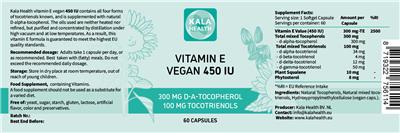
Supplement Facts
| Ingredient | Per serving | % DV | Upper limit (adults) |
|---|---|---|---|
| Vitamin E | 300 mg TE | 2,500% | — |
| Total Mixed Tocopherols | 300 mg | — | — |
| └ D-Alpha-Tocopherol | 300 mg | — | — |
| Total Mixed Tocotrienols | 100 mg | — | — |
| └ D-Alpha-Tocotrienol | 34 mg | — | — |
| └ D-Beta-Tocotrienol | 4.0 mg | — | — |
| └ D-Delta-Tocotrienol | 12 mg | — | — |
| └ D-Gamma-Tocotrienol | 50 mg | — | — |
| Plant Squalene | 10 mg | — | — |
| Phytosterols | 8.0 mg | — | — |
Upper limits: NIH ODS Fact Sheets for Health Professionals. Compared only where the unit converts and the limit applies to the form on the label.
On the label
For: Vegan · Vegetarian · Adult (18 - 50 Years) · Gluten Free · Dairy Free · Sugar Free
Claim types: Nutrient · All Other
All Other Content: RI= EU Reference Intake
Formula re: Contains: Kala Health Vitamin E vegan 450 IU contains all four known forms of tocotrienols known, and is supplemented with natural D-alpha-tocopherol. The oils used are not heated nor refined, but purified and concentrated by distillation under high vacuum ad at low temperatures. As a result, this vitamin E formula is guaranteed to meet the highest EU quality standards.
Suggested/Recommended/Usage/Directions: Recommended dosage: Adults take 1 capsule per day, or as recommended. Best taken with (fatty) meals. Do not exceed the recommended daily dosage.
Storage: Storage: Store in a dry place at room temperature, out of reach of young children.
Precautions re: Children: Storage: Store in a dry place at room temperature, out of reach of young children.
Formula re: Contains: Food supplement, containing vitamins.
This page repeats what the label says and the official upper limits for healthy adults. It is not medical advice: ask a doctor, pharmacist or registered dietitian about your own intake, especially if you are pregnant, take medicines or have a health condition.
Label data: NIH Office of Dietary Supplements, Dietary Supplement Label Database (dsld.od.nih.gov), public domain. Upper limits: NIH ODS Fact Sheets for Health Professionals (values from the Institute of Medicine, Food and Nutrition Board).