Green Lipped Mussel Oil
by Kala Health · Capsule
Supplement facts from the label of Green Lipped Mussel Oil by Kala Health: GlycOmega 100 mg, Olive Oil 200 mg, Total Omega-3 Fatty Acids 30 mg, Fatty Acids 0.40 mg….
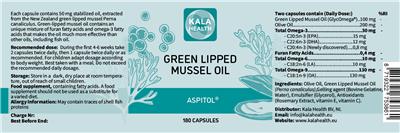
Supplement Facts
| Ingredient | Per serving | % DV | Upper limit (adults) |
|---|---|---|---|
| GlycOmega (Green Lipped Mussel Oil) | 100 mg | — | — |
| Olive Oil | 200 mg | — | — |
| Total Omega-3 Fatty Acids | 30 mg | — | — |
| └ Eicosapentaenoic Acid | 15 mg | — | — |
| └ Docosahexaenoic Acid | 0.00 NP | — | — |
| └ Eicosatetraenoic Acid | 0.00 NP | — | — |
| Fatty Acids | 0.40 mg | — | — |
| Total Omega-6 Fatty Acids | 10 mg | — | — |
| └ Linoleic Acid | 10 mg | — | — |
| Total Omega-9 Fatty Acids | 130 mg | — | — |
| └ Oleic Acid | 130 mg | — | — |
Upper limits: NIH ODS Fact Sheets for Health Professionals. Compared only where the unit converts and the limit applies to the form on the label.
On the label
For: Children 4 or More Years of Age · Adult (18 - 50 Years)
Claim types: Nutrient · All Other
Formula re: Contains: Each capsule contains 50 mg stabilized oil, extracted from the New Zealand green lipped mussel Perna Canaliculus. Green-Lipped mussel oil contains an unique mixture of furan fatty acids and Omega-3 fatty acids that makes the oil much more effective than other oils, including fish oil. Food Supplement, Containing Fatty Acids.
Suggested/Recommended/Usage/Directions: Recommended Dose: During the first 4-6 weeks take 2 capsules twice daily, then 1 capsule twice daily or as recommended. For children adapt dosage according to body weight. Best taken with a meal.
Precautions re: All Other: Do not exceed the recommended daily dosage.
Storage: Storage: Store in a dark, dry place at room temperature, out of reach of small children.
Precautions re: Children: Storage: Store in a dark, dry place at room temperature, out of reach of small children.
Precautions re: All Other: A food supplement should not be used as a substitute for a varied diet.
This page repeats what the label says and the official upper limits for healthy adults. It is not medical advice: ask a doctor, pharmacist or registered dietitian about your own intake, especially if you are pregnant, take medicines or have a health condition.
Label data: NIH Office of Dietary Supplements, Dietary Supplement Label Database (dsld.od.nih.gov), public domain. Upper limits: NIH ODS Fact Sheets for Health Professionals (values from the Institute of Medicine, Food and Nutrition Board).