Borage Oil 1,000 mg
by Woodstock Vitamins · Softgel Capsule
Supplement facts from the label of Borage Oil 1,000 mg by Woodstock Vitamins: Calories 10 Calorie(s), Total Fat 1.0 Gram(s), Borage Oil 1,000 mg, Linoleic Acid 370 mg….
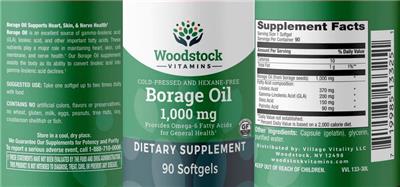
Supplement Facts
| Ingredient | Per serving | % DV | Upper limit (adults) |
|---|---|---|---|
| Calories | 10 Calorie(s) | — | — |
| Total Fat | 1.0 Gram(s) | 1% | — |
| Borage Oil (Borage) | 1,000 mg | — | — |
| Linoleic Acid | 370 mg | — | — |
| Gamma-Linolenic Acid | 200 mg | — | — |
| Oleic Acid | 150 mg | — | — |
| Palmitic Acid | 90 mg | — | — |
Upper limits: NIH ODS Fact Sheets for Health Professionals. Compared only where the unit converts and the limit applies to the form on the label.
On the label
For: Adult (18 - 50 Years) · Gluten Free · Dairy Free
Claim types: Nutrient · All Other · Structure/Function
Formulation re: Other: Borage Oil supports heart, skin, & nerve health
Formula re: Contains: Borage Oil is an excellent source of gamma-linolenic acid (GLA), linoleic acid, and other important fatty acids. These nutrients play a major role in maintaining heart, skin, cell membrane and nerve health. Our Borage Oil supplement assists the body as its ability to convert linoleic acid into gamma-linolenic acid declines.
Suggested/Recommended/Usage/Directions: Suggested Use: Take one softgel up to two times daily with food.
Formulation re: Does NOT Contain: Contains no artificial colors, flavors or preservatives; no wheat, gluten, milk, eggs, peanuts, tree nuts, soy, crustacean shellfish or fish.
Storage: Store in a cool, dry place.
Formulation re: Other: We guarantee our supplements for potency and purity
This page repeats what the label says and the official upper limits for healthy adults. It is not medical advice: ask a doctor, pharmacist or registered dietitian about your own intake, especially if you are pregnant, take medicines or have a health condition.
Label data: NIH Office of Dietary Supplements, Dietary Supplement Label Database (dsld.od.nih.gov), public domain. Upper limits: NIH ODS Fact Sheets for Health Professionals (values from the Institute of Medicine, Food and Nutrition Board).