Gold Standard 100% Whey Double Rich Chocolate
by Optimum Nutrition · Powder
Supplement facts from the label of Gold Standard 100% Whey Double Rich Chocolate by Optimum Nutrition: Calories 120 Calorie(s), Total Fat 1.0 Gram(s), Cholesterol 35 mg, Sodium 105 mg….
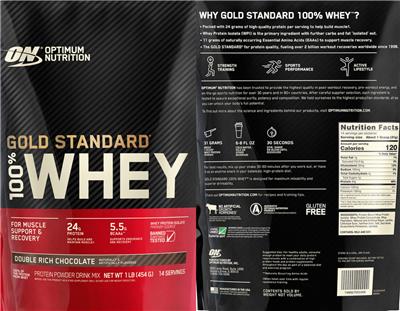
Supplement Facts
| Ingredient | Per serving | % DV | Upper limit (adults) |
|---|---|---|---|
| Calories | 120 Calorie(s) | — | — |
| Total Fat | 1.0 Gram(s) | 1% | — |
| └ Saturated Fat | 0.50 Gram(s) | 3% | — |
| Cholesterol | 35 mg | 12% | — |
| Sodium | 105 mg | 5% | — |
| Total Carbohydrate | 4.0 Gram(s) | 1% | — |
| └ Total Sugars | 1.0 Gram(s) | — | — |
| Protein | 24 Gram(s) | 48% | — |
| Calcium | 130 mg | 10% | 2,500 mg |
| Potassium | 150 mg | 4% | — |
Upper limits: NIH ODS Fact Sheets for Health Professionals. Compared only where the unit converts and the limit applies to the form on the label.
On the label
For: Adult (18 - 50 Years) · Gluten Free
Claim types: Nutrient · All Other · Structure/Function
Formulation re: Other: For muscle support and recovery
Formula re: Contains: 24g protein 5.5g BCAAs Naturally occurring amino acids Whey protein isolate Primary source
Formulation re: Other: Helps build and maintain muscle When taken over time with regular resistance training. Supports endurance and recovery
Seals/Symbols: Informed-Choice.org Trusted by sport Informed Choice is a quality assurance program for sports nutrition products. The program certifies that nutritional supplements that bear the informed choice logo have been tested for banned substances by the world class sports anti-doping lab, LCG Limited.
Formula re: Contains: Double rich chocolate Natural & artificially flavored 100% of the protein from whey
Formula re: Contains: Protein powder drink mix
This page repeats what the label says and the official upper limits for healthy adults. It is not medical advice: ask a doctor, pharmacist or registered dietitian about your own intake, especially if you are pregnant, take medicines or have a health condition.
Label data: NIH Office of Dietary Supplements, Dietary Supplement Label Database (dsld.od.nih.gov), public domain. Upper limits: NIH ODS Fact Sheets for Health Professionals (values from the Institute of Medicine, Food and Nutrition Board).