Creatine 500g
by Beyond Health · Powder
Supplement facts from the label of Creatine 500g by Beyond Health: Creatine Monohydrate 5,000 mg.
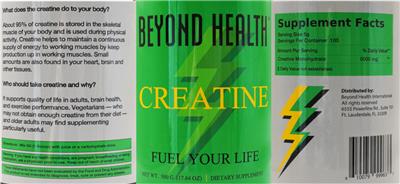
Supplement Facts
| Ingredient | Per serving | % DV | Upper limit (adults) |
|---|---|---|---|
| Creatine Monohydrate | 5,000 mg | — | — |
Upper limits: NIH ODS Fact Sheets for Health Professionals. Compared only where the unit converts and the limit applies to the form on the label.
On the label
For: Adult (18 - 50 Years)
Claim types: All Other · Structure/Function
Formula re: Contains: What does the creatine do to your body? About 95% of creatine is stored in the skeletal muscle of your body and is used during physical activity. Creatine helps to maintain a continuous supply of energy to working muscles by keep production up in working muscles by keep production up in working muscles. Small amounts are also found in your heart, brain and other tissues.
Formulation re: Other: Who should take creatine and why? It supports quality of life in adults, brain health, and exercise performance. Vegetarians - who may not obtain enough creatine from their diet - and older adults may find supplementing particularly useful.
Suggested/Recommended/Usage/Directions: Directions: Mix 5G (1 Scoop) with juice or a carbohydrate drink.
Precautions re: Pregnant or Nursing or Prescription Medications: Warning: If you have any health conditions, are pregnant, breastfeeding, or taking medication, ask a physician prior to use.
Precautions re: Children: Keep out of reach of small children.
FDA Disclaimer Statement: These statements have not been evaluated by the Food and Drug Administration. This product is not intended to diagnose, treat, cure or prevent any disease.
This page repeats what the label says and the official upper limits for healthy adults. It is not medical advice: ask a doctor, pharmacist or registered dietitian about your own intake, especially if you are pregnant, take medicines or have a health condition.
Label data: NIH Office of Dietary Supplements, Dietary Supplement Label Database (dsld.od.nih.gov), public domain. Upper limits: NIH ODS Fact Sheets for Health Professionals (values from the Institute of Medicine, Food and Nutrition Board).