Coriander Seed
by Banyan Botanicals · Powder
Supplement facts from the label of Coriander Seed by Banyan Botanicals: Coriander 1.0 Teaspoon(s).
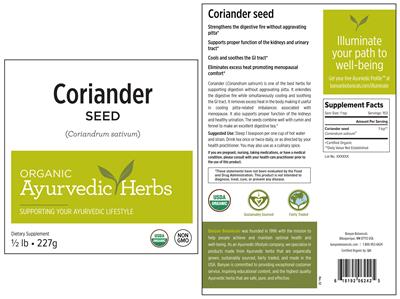
Supplement Facts
| Ingredient | Per serving | % DV | Upper limit (adults) |
|---|---|---|---|
| Coriander | 1.0 Teaspoon(s) | — | — |
Upper limits: NIH ODS Fact Sheets for Health Professionals. Compared only where the unit converts and the limit applies to the form on the label.
On the label
For: Adult (18 - 50 Years) · Organic · Menopause · Seniors/Mature (>50 Years) - Women ONLY
Claim types: All Other · Structure/Function
Formula re: Contains: (Coriandrum sativum) Organic ayurvedic herbs
Formulation re: Other: Supporting your ayurvedic lifestyle
Seals/Symbols: USDA Organic Sustainably Sourced Fairly Traded
Formulation re: Does NOT Contain: Non GMO
Formulation re: Other: Strengthens the digestive fire without aggravating pitta Supports proper function of the kidneys and urinary tract Cools and soothes the GI tract Eliminates excess heat promoting menopausal comfort
Formula re: Contains: Coriander (Coriandrum sativum) is one of the best herbs for supporting digestion without aggravating pitta. It enkindles the digestive fire while simultaneously cooling and soothing the GI tract. It removes excess heat in the body making it useful in cooling pitta-related imbalances associated with menopause. It also supports proper function of the kidneys and healthy urination. The seeds combine
This page repeats what the label says and the official upper limits for healthy adults. It is not medical advice: ask a doctor, pharmacist or registered dietitian about your own intake, especially if you are pregnant, take medicines or have a health condition.
Label data: NIH Office of Dietary Supplements, Dietary Supplement Label Database (dsld.od.nih.gov), public domain. Upper limits: NIH ODS Fact Sheets for Health Professionals (values from the Institute of Medicine, Food and Nutrition Board).