Dong Quai
by Body Ecology · Liquid
Supplement facts from the label of Dong Quai by Body Ecology: Calories 5.0 Calorie(s), Total Carbohydrate 2.0 Gram(s), Sodium 470 mg, Potassium 186 mg.
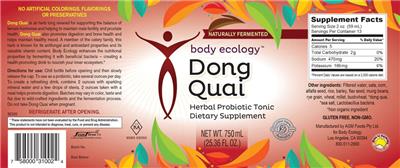
Supplement Facts
| Ingredient | Per serving | % DV | Upper limit (adults) |
|---|---|---|---|
| Calories | 5.0 Calorie(s) | — | — |
| Total Carbohydrate | 2.0 Gram(s) | 0% | — |
| Sodium | 470 mg | 20% | — |
| Potassium | 186 mg | 6% | — |
Upper limits: NIH ODS Fact Sheets for Health Professionals. Compared only where the unit converts and the limit applies to the form on the label.
On the label
For: Adult (18 - 50 Years) · Kosher · Women (not pregnant or lactating) · Organic · Gluten Free
Claim types: All Other · Structure/Function
Formulation re: Does NOT Contain: No artificial colorings, flavorings or preservatives
Formula re: Contains: Dong Quai is an herb long revered for supporting the balance of female hormones and helping to maintain male fertility and prostate health. Dong Quai also promotes digestion and bone health and helps maintain healthy mood. A member of the celery family, this herb is known for its antifungal and antioxidant properties and its valuable vitamin content. Body Ecology enhances the nutritional propertie
Suggested/Recommended/Usage/Directions: Directions for use: Chill bottle before opening and then slowly release the cap. To use as a probiotic, take several ounces per day. To create a refreshing drink, combine 2 ounces with sparkling mineral water and a few drops of stevia. 2 ounces taken with a meal helps promote digestion.
Formulation re: Other: Batches may vary in color, taste and fizz due to wild-crafted ingredients and the fermentation process.
Precautions re: Pregnant or Nursing or Prescription Medications: Do not take Dong Quai while pregnant.
Storage: Refrigerate after opening.
This page repeats what the label says and the official upper limits for healthy adults. It is not medical advice: ask a doctor, pharmacist or registered dietitian about your own intake, especially if you are pregnant, take medicines or have a health condition.
Label data: NIH Office of Dietary Supplements, Dietary Supplement Label Database (dsld.od.nih.gov), public domain. Upper limits: NIH ODS Fact Sheets for Health Professionals (values from the Institute of Medicine, Food and Nutrition Board).