DHEA 50
by Allergy Research Group · Tablet or Pill
Supplement facts from the label of DHEA 50 by Allergy Research Group: Dehydroepiandrosterone 50 mg.
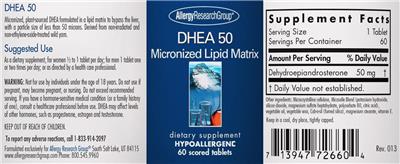
Supplement Facts
| Ingredient | Per serving | % DV | Upper limit (adults) |
|---|---|---|---|
| Dehydroepiandrosterone | 50 mg | — | — |
Upper limits: NIH ODS Fact Sheets for Health Professionals. Compared only where the unit converts and the limit applies to the form on the label.
On the label
For: Adult (18 - 50 Years) · Women (not pregnant or lactating)
Claim types: Nutrient · All Other
Formula re: Contains: Micronized, plant-sourced DHEA formulated in a lipid matrix to bypass the liver, with a particle size of less than 50 microns. Derived from non-irradiated and non-ethylene-oxide-treated wild yam.
Formulation re: Does NOT Contain: Derived from non-irradiated and non-ethylene-oxide-treated wild yam.
Suggested/Recommended/Usage/Directions: Suggested use As a dietary supplement, for women 1/2 to 1 tablet per day; for men 1 tablet one or two times per day; or as directed by a health care professional.
Precautions re: Children: Warning: Not for use by individuals under the age of 18 years.
Precautions re: Pregnant or Nursing or Prescription Medications: Do not use if pregnant, may become pregnant, or nursing.
Precautions re: All Other: Do not exceed recommended serving. If you have a hormone-sensitive medical condition (or a family history of one), consult a healthcare professional before use. DHEA may affect levels of other hormones, such as progesterone, estrogen and testosterone.
This page repeats what the label says and the official upper limits for healthy adults. It is not medical advice: ask a doctor, pharmacist or registered dietitian about your own intake, especially if you are pregnant, take medicines or have a health condition.
Label data: NIH Office of Dietary Supplements, Dietary Supplement Label Database (dsld.od.nih.gov), public domain. Upper limits: NIH ODS Fact Sheets for Health Professionals (values from the Institute of Medicine, Food and Nutrition Board).