DHEA 10
by Allergy Research Group · Tablet or Pill
Supplement facts from the label of DHEA 10 by Allergy Research Group: Dehydroepiandrosterone 10 mg.
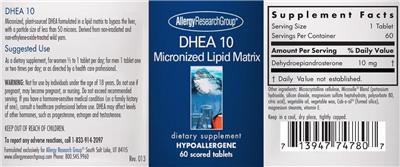
Supplement Facts
| Ingredient | Per serving | % DV | Upper limit (adults) |
|---|---|---|---|
| Dehydroepiandrosterone | 10 mg | — | — |
Upper limits: NIH ODS Fact Sheets for Health Professionals. Compared only where the unit converts and the limit applies to the form on the label.
On the label
For: Adult (18 - 50 Years) · Women (not pregnant or lactating)
Claim types: All Other · Structure/Function
Formula re: Contains: Micronized, plant-sourced DHEA formulated in a lipid matrix to bypass the liver, with a particle size of less than 50 microns. Derived from non-irradiated and non-ethylene-oxide-treated wild yam.
Suggested/Recommended/Usage/Directions: Suggested use As a dietary supplement, for women 1/2 to 1 tablet per day; for men 1 tablet one or two times per day; or as directed by a health care professional.
Precautions re: Children: Warning: Not for use by individuals under the age of 18 years.
Precautions re: Pregnant or Nursing or Prescription Medications: Do not use if pregnant, may become pregnant, or nursing.
Precautions re: All Other: Do not exceed recommended serving. If you have a hormone-sensitive medical condition (or a family history of one), consult a healthcare professional before use. DHEA may affect levels of other hormones, such as progesterone, estrogen and testosterone.
Precautions re: Children: Keep out of reach of children.
This page repeats what the label says and the official upper limits for healthy adults. It is not medical advice: ask a doctor, pharmacist or registered dietitian about your own intake, especially if you are pregnant, take medicines or have a health condition.
Label data: NIH Office of Dietary Supplements, Dietary Supplement Label Database (dsld.od.nih.gov), public domain. Upper limits: NIH ODS Fact Sheets for Health Professionals (values from the Institute of Medicine, Food and Nutrition Board).