DHA Fish Oil Concentrate
by Allergy Research Group · Softgel Capsule
Supplement facts from the label of DHA Fish Oil Concentrate by Allergy Research Group: Calories 5.0 Calorie(s), Total Fat 0.50 Gram(s), Fish Oil 600 mg….
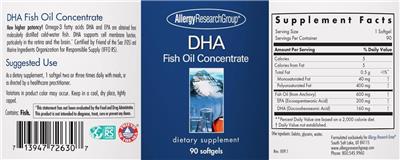
Supplement Facts
| Ingredient | Per serving | % DV | Upper limit (adults) |
|---|---|---|---|
| Calories | 5.0 Calorie(s) | — | — |
| └ Calories from Fat | 5.0 Calorie(s) | — | — |
| Total Fat | 0.50 Gram(s) | 1% | — |
| └ Monounsaturated Fat | 40 mg | — | — |
| └ Polyunsaturated Fat | 400 mg | — | — |
| Fish Oil (Anchovy) | 600 mg | — | — |
| └ Eicosapentaenoic Acid | 200 mg | — | — |
| └ Docosahexaenoic Acid | 160 mg | — | — |
Upper limits: NIH ODS Fact Sheets for Health Professionals. Compared only where the unit converts and the limit applies to the form on the label.
On the label
For: Adult (18 - 50 Years)
Claim types: Nutrient · All Other · Structure/Function
Formula re: Contains: New higher potency! Omega-3 fatty acids DHA and EPA are obtained from molecularly distilled cold-water fish. DHA supports cell membrane function, particularly in the retina and the brain. Certified by Friend of the Sea (FOS) and Marine Ingredients Organization for Responsible Supply (IFFO RS).
Suggested/Recommended/Usage/Directions: Suggested use As a dietary supplement, 1 softgel two or three times daily with meals, or as directed by a healthcare practitioner.
Formulation re: Other: Variations in product color may occur.
Storage: Keep in a cool, dry place, tightly capped.
Precautions re: Allergies: Contains: Fish.
FDA Disclaimer Statement: This statement has not been evaluated by the Food and Drug Administration. This product is not intended to diagnose, treat, cure or prevent any disease.
This page repeats what the label says and the official upper limits for healthy adults. It is not medical advice: ask a doctor, pharmacist or registered dietitian about your own intake, especially if you are pregnant, take medicines or have a health condition.
Label data: NIH Office of Dietary Supplements, Dietary Supplement Label Database (dsld.od.nih.gov), public domain. Upper limits: NIH ODS Fact Sheets for Health Professionals (values from the Institute of Medicine, Food and Nutrition Board).