Lutein with FloraGLO 20 mg
by Doctor's Best · Softgel Capsule
Supplement facts from the label of Lutein with FloraGLO 20 mg by Doctor's Best: FloraGLO 20 mg, FloraGLO 1.0 mg.
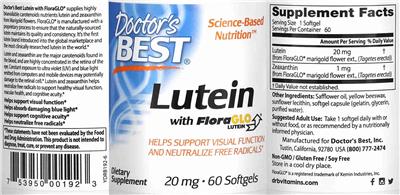
Supplement Facts
| Ingredient | Per serving | % DV | Upper limit (adults) |
|---|---|---|---|
| FloraGLO (Lutein) | 20 mg | — | — |
| FloraGLO (Zeaxanthin) | 1.0 mg | — | — |
Upper limits: NIH ODS Fact Sheets for Health Professionals. Compared only where the unit converts and the limit applies to the form on the label.
On the label
For: Adult (18 - 50 Years) · Gluten Free
Claim types: All Other · Structure/Function
Formula re: Contains: Doctor's Best Lutein with FloraGLO supplies highly bioavailable carotenoids nutrients lutein and zeaxanthin from Marigold flowers.
Formulation re: Other: FloraGLO is manufactured with a proprietary process to ensure that the naturally-sourced lutein maintains its quality and consistency. It's the first lutein brand introduced into the global marketplace and the most clinically researched lutein in the world. Lutein and zeaxanthin are the major carotenoids found in the blood, and are highly concentrated in the retina of the eye.
All Other Content: Constant exposure to ultra violet (UV) and blue light emitted from computers and mobile devices may potentially damage to the retinal cell.
Formulation re: Other: Helps support visual function Helps absorb damaging blue light Helps support cognitive acuity Helps neutralize free radicals
FDA Disclaimer Statement: These statements have not been evaluated by the Food and Drug Administration. This product is not intended to diagnose, treat, cure, or prevent any disease.
Brand IP Statement(s) re: (c), (TM), (SM): Doctor's Best Science-Based Nutrition
This page repeats what the label says and the official upper limits for healthy adults. It is not medical advice: ask a doctor, pharmacist or registered dietitian about your own intake, especially if you are pregnant, take medicines or have a health condition.
Label data: NIH Office of Dietary Supplements, Dietary Supplement Label Database (dsld.od.nih.gov), public domain. Upper limits: NIH ODS Fact Sheets for Health Professionals (values from the Institute of Medicine, Food and Nutrition Board).