D-Ribose with BioEnergy Ribose 850 mg
by Doctor's Best · Capsule
Supplement facts from the label of D-Ribose with BioEnergy Ribose 850 mg by Doctor's Best: Calories 15 Calorie(s), Total Carbohydrates 4.0 Gram(s), Bioenergy Ribose 4,250 mg.
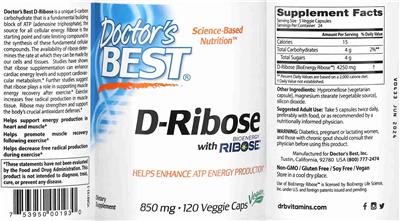
Supplement Facts
| Ingredient | Per serving | % DV | Upper limit (adults) |
|---|---|---|---|
| Calories | 15 Calorie(s) | — | — |
| Total Carbohydrates | 4.0 Gram(s) | 2% | — |
| └ Total Sugars | 4.0 Gram(s) | — | — |
| Bioenergy Ribose (D-Ribose) | 4,250 mg | — | — |
Upper limits: NIH ODS Fact Sheets for Health Professionals. Compared only where the unit converts and the limit applies to the form on the label.
On the label
For: Vegan · Vegetarian · Adult (18 - 50 Years) · Gluten Free · Dairy Free
Claim types: Nutrient · All Other · Structure/Function
Formula re: Contains: Doctor's Best D-Ribose is a unique 5-carbon carbohydrate that is a fundamental building block of ATP (adenosine triphosphate), the source for all cellular energy. Ribose is the starting point and rate limiting compound in the synthesis of these fundamental cellular compounds. The availability of ribose determines the rate at which they can be made by our cells and tissues. Studies have shown that
FDA Disclaimer Statement: These statements have not been evaluated by the Food and Drug Administration. This product is not intended to diagnose, treat, cure, or prevent any disease.
Brand IP Statement(s) re: (c), (TM), (SM): Science-Based Nutrition
Formulation re: Other: Helps enhance ATP energy production
Formulation re: Vegetarian/Vegan: Vegan
Suggested/Recommended/Usage/Directions: Suggested adult use: Take 5 capsules twice daily, preferably with food, or as recommended by a nutritionally informed physician.
This page repeats what the label says and the official upper limits for healthy adults. It is not medical advice: ask a doctor, pharmacist or registered dietitian about your own intake, especially if you are pregnant, take medicines or have a health condition.
Label data: NIH Office of Dietary Supplements, Dietary Supplement Label Database (dsld.od.nih.gov), public domain. Upper limits: NIH ODS Fact Sheets for Health Professionals (values from the Institute of Medicine, Food and Nutrition Board).