Kinoko Gold AHCC 500 mg
by Quality of Life · Capsule
Supplement facts from the label of Kinoko Gold AHCC 500 mg by Quality of Life: AHCC Proprietary Blend 1.0 Gram(s)….
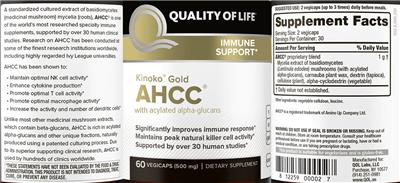
Supplement Facts
| Ingredient | Per serving | % DV | Upper limit (adults) |
|---|---|---|---|
| AHCC Proprietary Blend | 1.0 Gram(s) | — | — |
| └ Lentinula edodes Mycelia Extract (Alpha-Glucans, Acylated) | 0.00 NP | — | — |
| └ Carnauba plant Wax | 0.00 NP | — | — |
| └ Dextrin (Tapioca) | 0.00 NP | — | — |
| └ Cellulose | 0.00 NP | — | — |
| └ Alpha-Cyclodextrin | 0.00 NP | — | — |
Upper limits: NIH ODS Fact Sheets for Health Professionals. Compared only where the unit converts and the limit applies to the form on the label.
On the label
For: Vegetarian · Adult (18 - 50 Years) · Gluten Free
Claim types: All Other · Structure/Function
Formula re: Contains: A standardized cultured extract of basidiomycetes (medicinal mushroom) mycelia (roots), AHCC is one of the world's most researched specialty immune supplements, supported by over 30 human clinical studies.
Formulation re: Other: AHCC has been shown to: -Maintain optimal NK cell activity -Enhance cytokine production -Promote optimal T cell activity -Promote optimal macrophage activity -Increase the activity and number of dendritic cells
Formula re: Contains: Unlike most other medicinal mushroom extracts, which contain beta-glucans, AHCC is rich in acylated alpha-glucans and other unique fractions, naturally produced using a patented culturing process.
All Other Content: Due to its superior supporting clinical research, AHCC is used by hundreds of clinics worldwide.
FDA Disclaimer Statement: These statements have not been evaluated by the Food & Drug Administration. This product is not intended to diagnose, treat, cure, or prevent any disease.
Formulation re: Other: Immune support
This page repeats what the label says and the official upper limits for healthy adults. It is not medical advice: ask a doctor, pharmacist or registered dietitian about your own intake, especially if you are pregnant, take medicines or have a health condition.
Label data: NIH Office of Dietary Supplements, Dietary Supplement Label Database (dsld.od.nih.gov), public domain. Upper limits: NIH ODS Fact Sheets for Health Professionals (values from the Institute of Medicine, Food and Nutrition Board).