Paleo Thin Egg White Protein 21 g Vanilla
by Julian Bakery · Powder
Supplement facts from the label of Paleo Thin Egg White Protein 21 g Vanilla by Julian Bakery: Calories 110 Calorie(s), Total Fat 0.00 Gram(s), Cholesterol 0.00 mg, Sodium 380 mg….
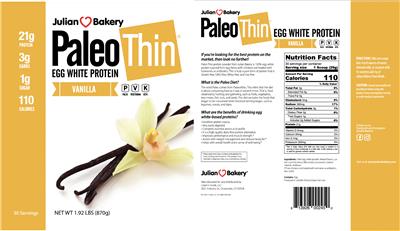
Supplement Facts
| Ingredient | Per serving | % DV | Upper limit (adults) |
|---|---|---|---|
| Calories | 110 Calorie(s) | — | — |
| Total Fat | 0.00 Gram(s) | 0% | — |
| └ Saturated Fat | 0.00 Gram(s) | 0% | — |
| └ Trans Fat | 0.00 Gram(s) | — | — |
| Cholesterol | 0.00 mg | 0% | — |
| Sodium | 380 mg | 17% | — |
| Total Carbohydrates | 3.0 Gram(s) | 1% | — |
| └ Dietary Fiber | 0.00 Gram(s) | 0% | — |
| └ Total Sugars | 1.0 Gram(s) | — | — |
| └ Added Sugars | 0.00 Gram(s) | 0% | — |
| Protein | 21 Gram(s) | — | — |
| Vitamin D | 0.00 mcg | 0% | 100 mcg |
| Calcium | 20 mg | 2% | 2,500 mg |
| Iron | 0.10 mg | 0% | 45 mg |
| Potassium | 300 mg | 6% | — |
Upper limits: NIH ODS Fact Sheets for Health Professionals. Compared only where the unit converts and the limit applies to the form on the label.
On the label
For: Vegetarian · Adult (18 - 50 Years) · Gluten Free · Dairy Free
Claim types: Nutrient · All Other · Structure/Function
Formula re: Contains: 21g Protein 3g Carbs 1g Sugar 110 Calories
Formula re: Type: Paleo Keto
Formulation re: Vegetarian/Vegan: Vegetarian
Formula re: Contains: If you're looking for the best protein on the market, then look no further! Paleo Thin protein powder from Julian Bakery is 100% egg white protein sourced from egg farms with chickens not treated with hormones or antibiotics.
Formulation re: Does NOT Contain: This is truly a pure from of protein that is gluten-free, gmo-free, whey-free and soy-free.
Formulation re: Other: What is the Paleo Diet? The word Paleo comes from Palaeolithic. This infers that the diet is about consuming food as it was in ancient times. That is, food obtained by hunting and gathering, such as fruits, vegetables, lean meats, fish, nuts, and seeds. This diet excludes the foods that began to be consumed when livestock farming began, such as legumes, cereals, and dairy. What are the benefits
This page repeats what the label says and the official upper limits for healthy adults. It is not medical advice: ask a doctor, pharmacist or registered dietitian about your own intake, especially if you are pregnant, take medicines or have a health condition.
Label data: NIH Office of Dietary Supplements, Dietary Supplement Label Database (dsld.od.nih.gov), public domain. Upper limits: NIH ODS Fact Sheets for Health Professionals (values from the Institute of Medicine, Food and Nutrition Board).