Paleo Thin Egg White Protein 21 g Espresso
by Julian Bakery · Powder
Supplement facts from the label of Paleo Thin Egg White Protein 21 g Espresso by Julian Bakery: Calories 110 Calorie(s), Total Fat 2.0 Gram(s), Cholesterol 0.00 mg, Sodium 350 mg….
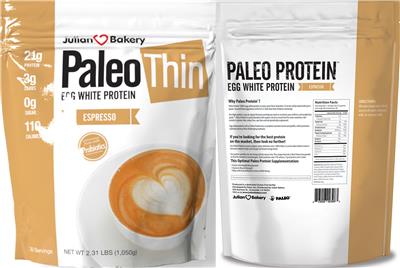
Supplement Facts
| Ingredient | Per serving | % DV | Upper limit (adults) |
|---|---|---|---|
| Calories | 110 Calorie(s) | — | — |
| └ Calories from Fat | 15 Calorie(s) | — | — |
| Total Fat | 2.0 Gram(s) | 3% | — |
| └ Saturated Fat | 2.0 Gram(s) | 10% | — |
| Cholesterol | 0.00 mg | 0% | — |
| Sodium | 350 mg | 15% | — |
| Total Carbohydrates | 3.0 Gram(s) | 1% | — |
| └ Dietary Fiber | 0.00 Gram(s) | 0% | — |
| Sugars | 0.00 Gram(s) | — | — |
| Protein | 21 Gram(s) | — | — |
| Vitamin A | 0.00 NP | 0% | — |
| Vitamin C | 0.00 NP | 0% | — |
| Calcium | 0.00 NP | 8% | — |
| Iron | 0.00 NP | 0% | — |
| Caffeine | 100 mg | — | — |
Upper limits: NIH ODS Fact Sheets for Health Professionals. Compared only where the unit converts and the limit applies to the form on the label.
On the label
For: Adult (18 - 50 Years) · Sugar Free
Claim types: Nutrient · All Other · Structure/Function
Formula re: Contains: 21g Protein 3g Carbs 110 Calories
Formulation re: Does NOT Contain: 0g Sugar
Formula re: Contains: Now with probiotics
Formula re: Contains: Why Paleo Protein? Paleo Protein 100% egg white protein is truly a pure form of protein. It can be easily mixed with just a spoon. Sourced from egg farms in the U.S.A. that treat their chickens humanely.
Formulation re: Other: Our high-protein, easy-to-digest formula can help you reach or maintain your wellness and weight loss goals.
Formula re: Contains: Paleo Protein is easily blended with organic stevia or monk fruit for extra sweetness.
This page repeats what the label says and the official upper limits for healthy adults. It is not medical advice: ask a doctor, pharmacist or registered dietitian about your own intake, especially if you are pregnant, take medicines or have a health condition.
Label data: NIH Office of Dietary Supplements, Dietary Supplement Label Database (dsld.od.nih.gov), public domain. Upper limits: NIH ODS Fact Sheets for Health Professionals (values from the Institute of Medicine, Food and Nutrition Board).