Yohimbine+ Rauwolscine
by ALLMAX · Capsule
Supplement facts from the label of Yohimbine+ Rauwolscine by ALLMAX: Yohimbine Hydrochloride 3.0 mg, Rauwolscine 0.50 mg.
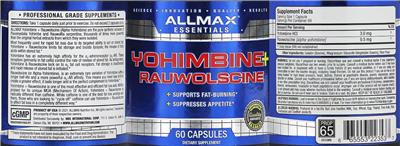
Supplement Facts
| Ingredient | Per serving | % DV | Upper limit (adults) |
|---|---|---|---|
| Yohimbine Hydrochloride | 3.0 mg | — | — |
| Rauwolscine (Alpha-Yohimbine) | 0.50 mg | — | — |
Upper limits: NIH ODS Fact Sheets for Health Professionals. Compared only where the unit converts and the limit applies to the form on the label.
On the label
For: Adult (18 - 50 Years) · Women (not pregnant or lactating)
Claim types: All Other · Structure/Function
All Other Content: Professional grade supplements
Suggested/Recommended/Usage/Directions: Directions: Take 1 capsule daily just prior to exercise. Do not exceed 2 capsules daily.
Formula re: Contains: Allmax Yohimbine + Rauwolscine (Alpha-Yohimbine) are the pure synthetic versions of Pausinystalia Yohimbine and Rauwolfia serpentina; thousands of times more powerful than the original herbal extracts from which they were isolated.
Formulation re: Other: Most frequently used for rapid fat loss due to its targeted ability to act on store fat, Yohimbine + Rauwolscine limits fat storage and boosts lipolysis; the release of fatty acids within stored fat. Yohimbine has an extremely high affinity for the Alpha 2-adrenoreceptor (Alpha 2-AR). These receptors (primarily in fat cells) control the rate of release of stored fat. As antagonists, Yohimbine & R
Formulation re: Other: While caffeine is one of the best fat loss analogs out there, those who are looking to "cycle off" caffeine can use Yohimbine + Rauwolscine to affect fat loss in a completely different way.
Seals/Symbols: cGMP Registered Facility
This page repeats what the label says and the official upper limits for healthy adults. It is not medical advice: ask a doctor, pharmacist or registered dietitian about your own intake, especially if you are pregnant, take medicines or have a health condition.
Label data: NIH Office of Dietary Supplements, Dietary Supplement Label Database (dsld.od.nih.gov), public domain. Upper limits: NIH ODS Fact Sheets for Health Professionals (values from the Institute of Medicine, Food and Nutrition Board).