Grass Fed Organ Complex
by Optimal Carnivore · Capsule
Supplement facts from the label of Grass Fed Organ Complex by Optimal Carnivore: Liver 540 mg, Brain 480 mg, Lamb Thymus 480 mg, Spleen 270 mg….
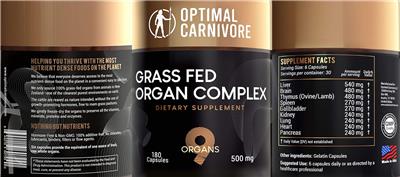
Supplement Facts
| Ingredient | Per serving | % DV | Upper limit (adults) |
|---|---|---|---|
| Liver | 540 mg | — | — |
| Brain | 480 mg | — | — |
| Lamb Thymus (Ovine) | 480 mg | — | — |
| Spleen | 270 mg | — | — |
| Gallbladder | 270 mg | — | — |
| Kidney | 240 mg | — | — |
| Lung | 240 mg | — | — |
| Heart | 240 mg | — | — |
| Pancreas | 240 mg | — | — |
Upper limits: NIH ODS Fact Sheets for Health Professionals. Compared only where the unit converts and the limit applies to the form on the label.
On the label
For: Adult (18 - 50 Years)
Claim types: All Other · Structure/Function
All Other Content: Helping you thrive with the most nutrient dense foods on the planet
Formula re: Contains: We believe that everyone deserves access to the most nutrient-dense food on the planet in a convenient easy way to take form. We only use 100% grass-fed organs from animals in New Zealand-one of the cleanest purest environments on earth. The cattle are reared as nature intended, without the use of growth-promoting hormones, free to roam grass pastures. Nothing but nutrients We gently freeze-dry
Formulation re: Does NOT Contain: Hormone-free and non-GMO. 100% additive-free. No stearates, lubricants, binders, fillers or flow agents.
Formula re: Contains: Six capsules provide the equivalent of one ounce of fresh, raw whole organs.
FDA Disclaimer Statement: These statements have not been evaluated by the Food and Drug administration. This product is not intended to diagnose, treat, cure, or prevent any disease.
Formula re: Contains: 9 organs 500 MG
This page repeats what the label says and the official upper limits for healthy adults. It is not medical advice: ask a doctor, pharmacist or registered dietitian about your own intake, especially if you are pregnant, take medicines or have a health condition.
Label data: NIH Office of Dietary Supplements, Dietary Supplement Label Database (dsld.od.nih.gov), public domain. Upper limits: NIH ODS Fact Sheets for Health Professionals (values from the Institute of Medicine, Food and Nutrition Board).