IgG 2000 CWP
by XYMOGEN · Powder
Supplement facts from the label of IgG 2000 CWP by XYMOGEN: Calories 20 Calorie(s), Protein 4.0 Gram(s), Calcium 40 mg, Bovine Colostral Whey Peptide 5.0 Gram(s)….
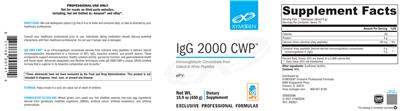
Supplement Facts
| Ingredient | Per serving | % DV | Upper limit (adults) |
|---|---|---|---|
| Calories | 20 Calorie(s) | — | — |
| Protein | 4.0 Gram(s) | — | — |
| Calcium (Colostral Whey Peptides) | 40 mg | 3% | 2,500 mg · 2% at label max |
| Bovine Colostral Whey Peptide (Immunoglobulin Concentrate) | 5.0 Gram(s) | — | — |
| └ Immunoglobulin G | 2.0 Gram(s) | — | — |
Upper limits: NIH ODS Fact Sheets for Health Professionals. Compared only where the unit converts and the limit applies to the form on the label.
On the label
For: Adult (18 - 50 Years) · Gluten Free
Claim types: Nutrient · All Other · Structure/Function
Precautions re: All Other: Professional use only Not for resale on third-party websites, including, but not limited to, Amazon and eBay.
Suggested/Recommended/Usage/Directions: Directions: mix one tablespoon (about 5 g) into 2-4 oz of water and consume daily, or take as directed by your healthcare professional.
Precautions re: All Other: Consult your healthcare professional prior to use.
Precautions re: Pregnant or Nursing or Prescription Medications: Individuals taking medication should discuss potential interactions with their healthcare professional.
Precautions re: All Other: Do not use if tamper seal is damaged.
Formula re: Contains: IgG 2000 CWP is an immunoglobin concentrate derived from colostral whey peptides. It delivers natural immunoglobins (standardized to a minimum of 40% IgG), bioactive proteins, and growth factors. These components support immune function, healthy cytokine activity, gut barrier function, and gastrointestinal health and tissue repair. Advanced coagulation and filtration techniques make IgG 2000 CWP a
This page repeats what the label says and the official upper limits for healthy adults. It is not medical advice: ask a doctor, pharmacist or registered dietitian about your own intake, especially if you are pregnant, take medicines or have a health condition.
Label data: NIH Office of Dietary Supplements, Dietary Supplement Label Database (dsld.od.nih.gov), public domain. Upper limits: NIH ODS Fact Sheets for Health Professionals (values from the Institute of Medicine, Food and Nutrition Board).