D-Mannose 500 mg
by Protocol For Life Balance · Capsule
Supplement facts from the label of D-Mannose 500 mg by Protocol For Life Balance: Calories 10 Calorie(s), Total Carbohydrates 2.0 Gram(s), D-Mannose 2.0 Gram(s).
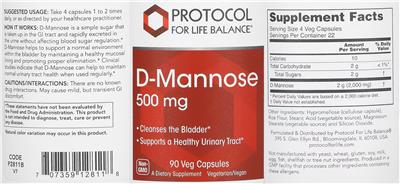
Supplement Facts
| Ingredient | Per serving | % DV | Upper limit (adults) |
|---|---|---|---|
| Calories | 10 Calorie(s) | — | — |
| Total Carbohydrates | 2.0 Gram(s) | 1% | — |
| └ Total Sugars | 2.0 Gram(s) | — | — |
| D-Mannose | 2.0 Gram(s) | — | — |
Upper limits: NIH ODS Fact Sheets for Health Professionals. Compared only where the unit converts and the limit applies to the form on the label.
On the label
For: Vegan · Vegetarian · Adult (18 - 50 Years) · Gluten Free · Dairy Free
Claim types: Nutrient · All Other · Structure/Function
Suggested/Recommended/Usage/Directions: Suggested usage: Take 4 capsules 1 to 2 times daily or as directed by your healthcare practitioner.
Formula re: Contains: How it works: D-Mannose is a simple sugar that is taken up in the GI tract and rapidly excreted in the urine without affecting blood sugar regulation. D-Mannose helps to support a normal environment within the bladder by maintaining a healthy mucosal lining and promoting proper elimination. Clinical studied indicate that D-Mannose can help to maintain normal urinary tract health when used regularl
Precautions re: Pregnant or Nursing or Prescription Medications: Cautions/interactions: There are no known drug interactions.
FDA Disclaimer Statement: These statements have not been evaluated by the Food and Drug Administration. This product is not intended to diagnose, treat, cure or prevent any disease.
Formulation re: Other: Natural color variation may occur in this product.
Formulation re: Other: Cleanses the bladder Supports a healthy urinary tract
This page repeats what the label says and the official upper limits for healthy adults. It is not medical advice: ask a doctor, pharmacist or registered dietitian about your own intake, especially if you are pregnant, take medicines or have a health condition.
Label data: NIH Office of Dietary Supplements, Dietary Supplement Label Database (dsld.od.nih.gov), public domain. Upper limits: NIH ODS Fact Sheets for Health Professionals (values from the Institute of Medicine, Food and Nutrition Board).