MCT Oil
by NutraKey · Liquid
Supplement facts from the label of MCT Oil by NutraKey: Calories 130 Calorie(s), Total Fat 14 Gram(s), Medium Chain Triglycerides 14 Gram(s)….
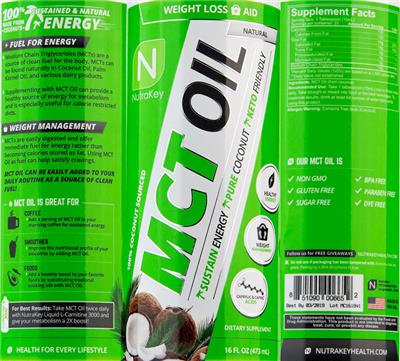
Supplement Facts
| Ingredient | Per serving | % DV | Upper limit (adults) |
|---|---|---|---|
| Calories | 130 Calorie(s) | — | — |
| └ Calories from Fat | 130 Calorie(s) | — | — |
| Total Fat | 14 Gram(s) | 22% | — |
| └ Saturated Fat | 14 Gram(s) | 17% | — |
| └ Trans Fat | 0.00 Gram(s) | — | — |
| └ Polyunsaturated Fat | 0.00 Gram(s) | — | — |
| └ Monounsaturated Fat | 0.00 Gram(s) | — | — |
| Medium Chain Triglycerides | 14 Gram(s) | — | — |
Upper limits: NIH ODS Fact Sheets for Health Professionals. Compared only where the unit converts and the limit applies to the form on the label.
On the label
For: Adult (18 - 50 Years) · Gluten Free · Sugar Free
Claim types: Nutrient · All Other · Structure/Function
Formula re: Contains: 100% made from coconuts Sustained & natural energy Fuel for energy Medium Chain Triglycerides (MCTs) are a source of clean fuel for the body. MCTs can be found naturally in coconut oil, palm kernel oil, and various dairy products. Supplementing with MCT oil can provide a healthy source of energy for metabolism and is especially useful for calorie restricted diets. Weight management MCTs are
Suggested/Recommended/Usage/Directions: MCT oil can be easily added to your daily routine as a source of clean fuel! MCT oil is great for Coffee Add a serving of MCT oil in your morning coffee for sustained energy. Smoothies Improve the nutritional profile of your smoothie by adding MCT oil. Foods Add a healthy boost to your favorite foods by substituting traditional cooking oils with MCT oil. For best results: Take MCT oil twic
Brand IP Statement(s) re: (c), (TM), (SM): NutraKey Health for every lifestyle
Formulation re: Other: Weight loss aid Natural Sustain energy Healthy energy Weight management
Formula re: Contains: 100% coconut sourced MCT Oil Pure coconut Caprylic & capric acids
Formula re: Type: Keto friendly
This page repeats what the label says and the official upper limits for healthy adults. It is not medical advice: ask a doctor, pharmacist or registered dietitian about your own intake, especially if you are pregnant, take medicines or have a health condition.
Label data: NIH Office of Dietary Supplements, Dietary Supplement Label Database (dsld.od.nih.gov), public domain. Upper limits: NIH ODS Fact Sheets for Health Professionals (values from the Institute of Medicine, Food and Nutrition Board).