Leucine
by NutraKey · Powder
Supplement facts from the label of Leucine by NutraKey: L-Leucine 5,000 mg.
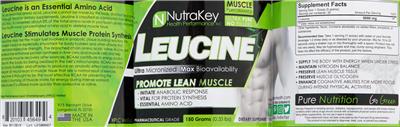
Supplement Facts
| Ingredient | Per serving | % DV | Upper limit (adults) |
|---|---|---|---|
| L-Leucine | 5,000 mg | — | — |
Upper limits: NIH ODS Fact Sheets for Health Professionals. Compared only where the unit converts and the limit applies to the form on the label.
On the label
For: Adult (18 - 50 Years)
Claim types: Nutrient · All Other · Structure/Function
Formula re: Contains: Leucine is an essential amino acid As an essential amino acid, Leucine cannot be made by the body, and must be acquired through food or dietary supplements. Leucine is classified as a branched-chain amino is (BCAA). It comprises about 8% of the total amino acids in your body's protein structures as the fourth most concentrated amino acid in skeletal muscle tissue.
Formulation re: Other: Leucine stimulates muscle protein synthesis Leucine may be the major fuel involved in anabolic (tissue building) reactions.
Formula re: Type: This makes Leucine especially important for body builders and other athletes that demand explosive strength.
Formula re: Contains: The branched chain amino acids: valine, leucine, and isoleucine enhanced protein synthesis in liver cells and muscle cells and help promote muscle recovery after exercise. BCAAs contibute to energy production in the body by being oxidized in the cell's mitochondria. BCAAs are used by body builders and athletes to produce and anabolic effect and assist in the repair of micro-tears in muscle tissue
Formulation re: Other: HPLC Verified
Brand IP Statement(s) re: (c), (TM), (SM): NutraKey Health Performance Inc
This page repeats what the label says and the official upper limits for healthy adults. It is not medical advice: ask a doctor, pharmacist or registered dietitian about your own intake, especially if you are pregnant, take medicines or have a health condition.
Label data: NIH Office of Dietary Supplements, Dietary Supplement Label Database (dsld.od.nih.gov), public domain. Upper limits: NIH ODS Fact Sheets for Health Professionals (values from the Institute of Medicine, Food and Nutrition Board).