Adora Probiotic for Kids Rich Milk Chocolate
by Adora · Other (e.g. tea bag)
Supplement facts from the label of Adora Probiotic for Kids Rich Milk Chocolate by Adora: Calories 35 Calorie(s), Calories from Saturated Fat 10 Calorie(s), Total Fat 2.5 Gram(s), Total Carbohydrates 4.0 Gram(s)….
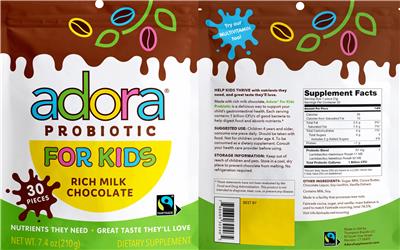
Supplement Facts
| Ingredient | Per serving | % DV | Upper limit (adults) |
|---|---|---|---|
| Calories | 35 Calorie(s) | — | — |
| Calories from Saturated Fat | 10 Calorie(s) | — | — |
| Total Fat | 2.5 Gram(s) | 3% | — |
| └ Saturated Fat | 1.5 Gram(s) | 7% | — |
| Total Carbohydrates | 4.0 Gram(s) | 1% | — |
| └ Total Sugars | 4.0 Gram(s) | — | — |
| └ added Sugars | 2.0 Gram(s) | 4% | — |
| Protein | 1.0 Gram(s) | — | — |
| Probiotic Blend | 67 mg | — | — |
| └ Lactobacillus rhamnosus Rosell-11 ME | 0.00 NP | — | — |
| └ Lactobacillus helveticus Rosell-52 ME | 0.00 NP | — | — |
Upper limits: NIH ODS Fact Sheets for Health Professionals. Compared only where the unit converts and the limit applies to the form on the label.
On the label
For: Children 4 or More Years of Age
Claim types: All Other · Structure/Function
Seals/Symbols: Fairtrade
All Other Content: Try our multivitamin too!
All Other Content: Help kids thrive with nutrients they need, and great taste they'll love.
Formula re: Contains: Made with rich milk chocolate, Adora For Kids Probiotic is a delicious way to support your child's gastrointestinal health. Each serving contains 1 billion CFU's of good bacteria to help digest food and absorb nutrients.
Suggested/Recommended/Usage/Directions: Suggested Use: Children 4 years and older, consume one piece daily. Should be taken with food. Not for children under age 4. To be consumed as a dietary supplement.
Precautions re: All Other: Consult your health care provider before using.
This page repeats what the label says and the official upper limits for healthy adults. It is not medical advice: ask a doctor, pharmacist or registered dietitian about your own intake, especially if you are pregnant, take medicines or have a health condition.
Label data: NIH Office of Dietary Supplements, Dietary Supplement Label Database (dsld.od.nih.gov), public domain. Upper limits: NIH ODS Fact Sheets for Health Professionals (values from the Institute of Medicine, Food and Nutrition Board).