PQQ-10
by Natural Factors · Softgel Capsule
Supplement facts from the label of PQQ-10 by Natural Factors: Calories 5.0 Calorie(s), Total Fat 0.50 Gram(s), Vitamin E 3.4 mg, Coenzyme Q10 200 mg….
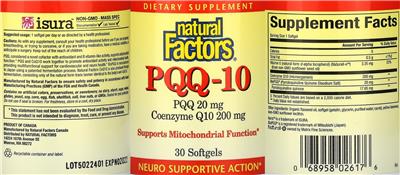
Supplement Facts
| Ingredient | Per serving | % DV | Upper limit (adults) |
|---|---|---|---|
| Calories | 5.0 Calorie(s) | — | — |
| Total Fat | 0.50 Gram(s) | 1% | — |
| Vitamin E (D-Alpha-Tocopherol, non-GMO Sunflower seed oil) | 3.4 mg | 22% | 1,000 mg · 0% at label max |
| Coenzyme Q10 | 200 mg | — | — |
| BioPQQ (Pyrroloquinoline Quinone Disodium Salt) | 20 mg | — | — |
| └ Pyrroloquinoline Quinone | 18 mg | — | — |
Upper limits: NIH ODS Fact Sheets for Health Professionals. Compared only where the unit converts and the limit applies to the form on the label.
On the label
For: Adult (18 - 50 Years) · Gluten Free · Dairy Free · Sugar Free
Claim types: All Other · Structure/Function
Seals/Symbols: ISURA Non-GMO Mass Spec Documentation Lab Tested
Suggested/Recommended/Usage/Directions: Suggested usage: 1 softgel per day or as directed by a health professional.
Precautions re: Pregnant or Nursing or Prescription Medications: Cautions: As with any supplement, consult your health professional before use if you are pregnant, breastfeeding, or trying to conceive, or if you are taking medication, have a medical condition, or anticipate a surgery.
Precautions re: Children: Keep out of the reach of children.
Formula re: Contains: PQQ, considered a novel cofactor with antioxidant and B vitamin-like activity, supports mitochondrial function. PQQ and CoQ10 work together to promote antioxidant activity and mitochondrial health, providing multifunctional support for cardiovascular and neuro health. BioPQQ is manufactured in Japan using a patented fermentation process. Natural Factors CoQ10 is also produced through fermentation,
Formulation re: Other: Manufactured by Natural Factors to ensure safety and potency in accordance with Good Manufacturing Practices (GMP) of the FDA and Health Canada.
This page repeats what the label says and the official upper limits for healthy adults. It is not medical advice: ask a doctor, pharmacist or registered dietitian about your own intake, especially if you are pregnant, take medicines or have a health condition.
Label data: NIH Office of Dietary Supplements, Dietary Supplement Label Database (dsld.od.nih.gov), public domain. Upper limits: NIH ODS Fact Sheets for Health Professionals (values from the Institute of Medicine, Food and Nutrition Board).