DAA
by NutraKey Health Performance · Powder
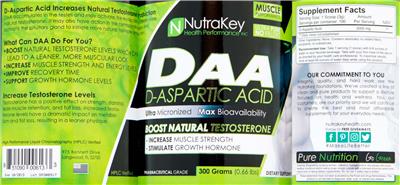
Supplement facts from the label of DAA by NutraKey Health Performance: D-Aspartic Acid 3,000 mg.
Supplement Facts
| Ingredient | Per serving | % DV | Upper limit (adults) |
|---|---|---|---|
| D-Aspartic Acid | 3,000 mg | — | — |
Upper limits: NIH ODS Fact Sheets for Health Professionals. Compared only where the unit converts and the limit applies to the form on the label.
On the label
For: Adult (18 - 50 Years)
Claim types: All Other · Structure/Function
Formula re: Contains: D-Aspartic Acid increases natural testosterone production DAA accumulates in the testes and may activate the Leydig cells to create more natural testosterone. It may also have action in the central brain region and activate the pituitary gland to initiate more natural hormone production.
Formulation re: Other: What can DAA do for you? Boost natural testosterone levels which can lead to a leaner, more muscular look Increase muscle strength and energy levels Improve recovery time Support growth with hormone levels Increase testosterone levels Testosterone has a positive effect on strength, stamina, lean muscle retention, and fat loss. Increased testosterone levels have a dramatic impact on metabolis
Formulation re: Other: High performance liquid chromatography (HPLC) verified Muscle performance
Formulation re: Does NOT Contain: Ultra pure no fillers
Formula re: Contains: D-Aspartic Acid
Formulation re: Other: Ultra micronized Max bioavailability Boost natural testosterone Increase muscle strength Stimulate growth hormone HPLC verified Pharmaceutical grade
This page repeats what the label says and the official upper limits for healthy adults. It is not medical advice: ask a doctor, pharmacist or registered dietitian about your own intake, especially if you are pregnant, take medicines or have a health condition.
Label data: NIH Office of Dietary Supplements, Dietary Supplement Label Database (dsld.od.nih.gov), public domain. Upper limits: NIH ODS Fact Sheets for Health Professionals (values from the Institute of Medicine, Food and Nutrition Board).