Ahiflower Oil Softgels
by Chief Originals · Softgel Capsule
Supplement facts from the label of Ahiflower Oil Softgels by Chief Originals: Calories 20 Calorie(s), Total Fat 2.3 Gram(s), Ahiflower (Buglossoides arvensis) seed oil 0.00 NP….
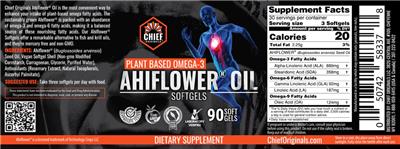
Supplement Facts
| Ingredient | Per serving | % DV | Upper limit (adults) |
|---|---|---|---|
| Calories | 20 Calorie(s) | — | — |
| Total Fat | 2.3 Gram(s) | 3% | — |
| Ahiflower (Buglossoides arvensis) seed oil | 0.00 NP | — | — |
| └ Omega-3 Fatty Acids | 0.00 NP | — | — |
| └ Alpha-Linolenic Acid | 889 mg | — | — |
| └ Stearidonic Acid | 358 mg | — | — |
| └ Omega-6 Fatty Acids | 0.00 NP | — | — |
| └ Gamma-Linolenic Acid | 92 mg | — | — |
| └ Linoleic Acid | 187 mg | — | — |
| └ Omega-9 Fatty Acids | 0.00 NP | — | — |
| └ Oleic Acid | 124 mg | — | — |
Upper limits: NIH ODS Fact Sheets for Health Professionals. Compared only where the unit converts and the limit applies to the form on the label.
On the label
For: Adult (18 - 50 Years)
Claim types: Nutrient · All Other · Structure/Function
Formula re: Contains: Chief Originals Ahiflower Oil is the most convenient way to enhance your intake of plant-based omega fatty acids. The sustainably grown Ahiflower is packed with an abundance of omega-3 and omega-6 fatty acids, making it a balanced source of these nourishing fatty acids. Our Ahiflower Softgels offer a remarkable alternative to fish and krill oils, and they’re mercury free and non-GMO.
Formulation re: Does NOT Contain: Our Ahiflower Softgels offer a remarkable alternative to fish and krill oils, and they’re mercury free and non-GMO.
Suggested/Recommended/Usage/Directions: Suggested Use: Take three softgels per day with food.
FDA Disclaimer Statement: These statements have not been evaluated by the Food and Drug Administration. This product is not intended to diagnose, treat, cure, or prevent any disease.
Brand IP Statement(s) re: (c), (TM), (SM): Ahiflower is a licensed trademark of Technology Crops LLC
Formula re: Contains: Plant based Omega-3
This page repeats what the label says and the official upper limits for healthy adults. It is not medical advice: ask a doctor, pharmacist or registered dietitian about your own intake, especially if you are pregnant, take medicines or have a health condition.
Label data: NIH Office of Dietary Supplements, Dietary Supplement Label Database (dsld.od.nih.gov), public domain. Upper limits: NIH ODS Fact Sheets for Health Professionals (values from the Institute of Medicine, Food and Nutrition Board).