Pau D'Arco 500 mg
by Source Naturals · Tablet or Pill
Supplement facts from the label of Pau D'Arco 500 mg by Source Naturals: Calcium 96 mg, Pau d'Arco bark extract 1.0 Gram(s).
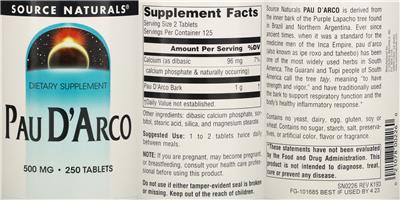
Supplement Facts
| Ingredient | Per serving | % DV | Upper limit (adults) |
|---|---|---|---|
| Calcium (Dibasic Calcium Phosphate) | 96 mg | 7% | 2,500 mg · 8% at label max |
| Pau d'Arco bark extract | 1.0 Gram(s) | — | — |
Upper limits: NIH ODS Fact Sheets for Health Professionals. Compared only where the unit converts and the limit applies to the form on the label.
On the label
For: Adult (18 - 50 Years) · Gluten Free · Dairy Free · Sugar Free
Claim types: All Other · Structure/Function
Suggested/Recommended/Usage/Directions: Suggested Use: 1 to 2 tablets twice daily between meals.
Precautions re: Pregnant or Nursing or Prescription Medications: Note: If you are pregnant, may become pregnant, or breastfeeding, consult your health care professional before using this product.
Precautions re: All Other: Do not use if either tamper-evident seal is broken or missing.
Precautions re: Children: Keep out of the reach of children.
Formula re: Contains: Source Naturals PAU D'ARCO is derived from the inner bark of the Purple Lapacho tree found in Brazil and Northern Argentina. Ever since ancient times, when it was a standard for the medicine men of the Inca Empire, pau d' arco (also known as ipe roxo and taheebo) has been one of the most widely used herbs in South America. The Guarani and Tupi people of South America call the tree tajy, meaning "t
Formulation re: Does NOT Contain: Contains no yeast, dairy, egg, gluten, soy or wheat. Contains no sugar, starch, salt, preservatives, or artificial color, flavor or fragrance.
This page repeats what the label says and the official upper limits for healthy adults. It is not medical advice: ask a doctor, pharmacist or registered dietitian about your own intake, especially if you are pregnant, take medicines or have a health condition.
Label data: NIH Office of Dietary Supplements, Dietary Supplement Label Database (dsld.od.nih.gov), public domain. Upper limits: NIH ODS Fact Sheets for Health Professionals (values from the Institute of Medicine, Food and Nutrition Board).