CLA 3000
by Metabolic Nutrition · Softgel Capsule
Supplement facts from the label of CLA 3000 by Metabolic Nutrition: Calories 30 Calorie(s), Total Fat 3.0 Gram(s), Total Carbohydrates 3.0 Gram(s), Safflower Oil 3,000 mg….
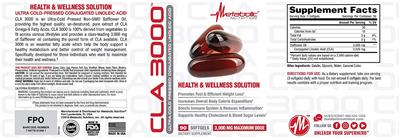
Supplement Facts
| Ingredient | Per serving | % DV | Upper limit (adults) |
|---|---|---|---|
| Calories | 30 Calorie(s) | — | — |
| └ Calories from Fat | 15 Calorie(s) | — | — |
| Total Fat | 3.0 Gram(s) | 4% | — |
| Total Carbohydrates | 3.0 Gram(s) | 1% | — |
| Safflower Oil | 3,000 mg | — | — |
| └ Conjugated Linoleic Acid | 2,520 mg | — | — |
Upper limits: NIH ODS Fact Sheets for Health Professionals. Compared only where the unit converts and the limit applies to the form on the label.
On the label
For: Adult (18 - 50 Years) · Women (not pregnant or lactating) · Gluten Free · Dairy Free
Claim types: All Other · Structure/Function
Formulation re: Other: Health & wellness solution
Formula re: Contains: Ultra cold-pressed conjugated linoleic acid CLA 3000 is an ultra-cold pressed non-GMO safflower oil, providing the highest quality, un-denatured, pure extract of CLA omega-6 fatty acids.
Formulation re: Does NOT Contain: CLA 3000 is an ultra-cold pressed non-GMO safflower oil, providing the highest quality, un-denatured, pure extract of CLA omega-6 fatty acids.
Formula re: Contains: CLA 3000 is 100% derived from vegetables to fit across various lifestyles and provides a class-leading 3,000 mg of safflower oil containing fatty acids which help the body support a healthy metabolism and better control of weight management.
Formula re: Type: Specifically developed for those individuals who want to maximize their health and wellness.
Formulation re: Does NOT Contain: This product does not contain: Gluten, dairy, egg, peanut, fish, soy, shellfish, wheat, yeast, fillers, binders, preservatives, artifiical ingredients.
This page repeats what the label says and the official upper limits for healthy adults. It is not medical advice: ask a doctor, pharmacist or registered dietitian about your own intake, especially if you are pregnant, take medicines or have a health condition.
Label data: NIH Office of Dietary Supplements, Dietary Supplement Label Database (dsld.od.nih.gov), public domain. Upper limits: NIH ODS Fact Sheets for Health Professionals (values from the Institute of Medicine, Food and Nutrition Board).