Phase 2 Carbohydrate Blocker 500 mg
by Source Naturals · Tablet or Pill
Supplement facts from the label of Phase 2 Carbohydrate Blocker 500 mg by Source Naturals: Calories 10 Calorie(s), Total Carbohydrate 2.0 Gram(s), Sodium 40 mg, Phase 2 1.0 Gram(s)….
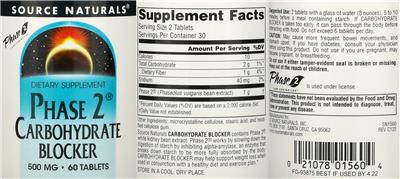
Supplement Facts
| Ingredient | Per serving | % DV | Upper limit (adults) |
|---|---|---|---|
| Calories | 10 Calorie(s) | — | — |
| Total Carbohydrate | 2.0 Gram(s) | 1% | — |
| └ Dietary Fiber | 1.0 Gram(s) | 4% | — |
| Sodium | 40 mg | 2% | — |
| Phase 2 (Phaseolus vulgaris bean extract) | 1.0 Gram(s) | — | — |
Upper limits: NIH ODS Fact Sheets for Health Professionals. Compared only where the unit converts and the limit applies to the form on the label.
On the label
For: Adult (18 - 50 Years) · Women (not pregnant or lactating)
Claim types: All Other · Structure/Function
Formula re: Contains: Phase 2 Carb Controller
Formula re: Contains: Phase 2 Carbohydrate Blocker 500 mg Source Naturals CARBOHYDRATE BLOCKER contains Phase 2 white kidney bean extract. Phase 2 works by slowing down the digestion of starch by inhibiting alpha-amylase, an enzyme that breaks down starch to be more fully absorbed by the body. CARBOHYDRATE BLOCKER may help support weight loss when used in conjunction with a healthy diet and exercise plan.
Storage: Store in a cool, dry place.
Suggested/Recommended/Usage/Directions: Suggested Use: 2 tablets with a glass of water (8 ounces), 5 to 10 minutes before a meal containing starch. If CARBOHYDRATE BLOCKER is taken too early, it can pass through the body before interacting with food. Do not exceed 6 tablets per day.
Precautions re: All Other: Caution: May cause more frequent bowel movements, and stomach upset. If you have diabetes, consult your physician before using this product.
Precautions re: Pregnant or Nursing or Prescription Medications: Do not use if you are pregnant, may become pregnant, or breastfeeding.
This page repeats what the label says and the official upper limits for healthy adults. It is not medical advice: ask a doctor, pharmacist or registered dietitian about your own intake, especially if you are pregnant, take medicines or have a health condition.
Label data: NIH Office of Dietary Supplements, Dietary Supplement Label Database (dsld.od.nih.gov), public domain. Upper limits: NIH ODS Fact Sheets for Health Professionals (values from the Institute of Medicine, Food and Nutrition Board).