Vitamin D3 1,000 IU (25 mcg) Berry Flavored
by Nature's Way · Liquid
Supplement facts from the label of Vitamin D3 1,000 IU (25 mcg) Berry Flavored by Nature's Way: Calories 0.00 Calorie(s), Total Carbohydrates 1.0 Gram(s), Vitamin D3 13 mcg….
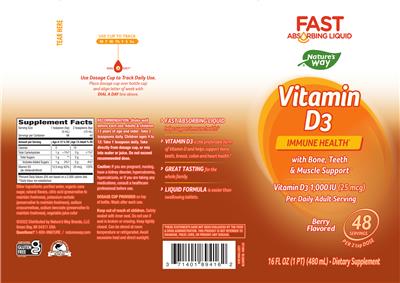
Supplement Facts
| Ingredient | Per serving | % DV | Upper limit (adults) |
|---|---|---|---|
| Calories | 0.00 Calorie(s) | — | — |
| Total Carbohydrates | 1.0 Gram(s) | 1% | — |
| └ Total Sugars | 1.0 Gram(s) | — | — |
| └ Added Sugars | 1.0 Gram(s) | 2% | — |
| Vitamin D3 (Cholecalciferol) | 13 mcg | 63% | 100 mcg · 13% at label max |
| Calories | — | — | — |
| Total Carbohydrates | — | — | — |
| └ Total Sugars | — | — | — |
| └ Added Sugars | — | — | — |
| Vitamin D3 (Cholecalciferol) | — | — | — |
Upper limits: NIH ODS Fact Sheets for Health Professionals. Compared only where the unit converts and the limit applies to the form on the label.
On the label
For: Children 4 or More Years of Age · Adult (18 - 50 Years) · Gluten Free
Claim types: Nutrient · All Other · Structure/Function
All Other Content: Use cup to track M T W Th F S Su Dial a day
Suggested/Recommended/Usage/Directions: Use dosage cup to track daily use. Place dosage cup over bottle cap and align letter of week with dial a day line above.
Brand IP Statement(s) re: (c), (TM), (SM): Copyright 2022 Distributed by Nature’s Way Brands, LLC
Seals/Symbols: Certified Gluten Free GFCO.org Quality Global Sourcing Bottled & Tested In the USA
Formulation re: Does NOT Contain: Certified Gluten Free GFCO.org
Suggested/Recommended/Usage/Directions: Recommendation: Shake well before each use. Adults & children 13 years of age and older: Take 2 teaspoons daily. Children ages 4 to 12: Take 1 teaspoon daily. Take directly from dosage cup, or mix into water or juice.
This page repeats what the label says and the official upper limits for healthy adults. It is not medical advice: ask a doctor, pharmacist or registered dietitian about your own intake, especially if you are pregnant, take medicines or have a health condition.
Label data: NIH Office of Dietary Supplements, Dietary Supplement Label Database (dsld.od.nih.gov), public domain. Upper limits: NIH ODS Fact Sheets for Health Professionals (values from the Institute of Medicine, Food and Nutrition Board).